
Your Body Has a Recovery Budget: Why Resources Matter
Sep 08, 2026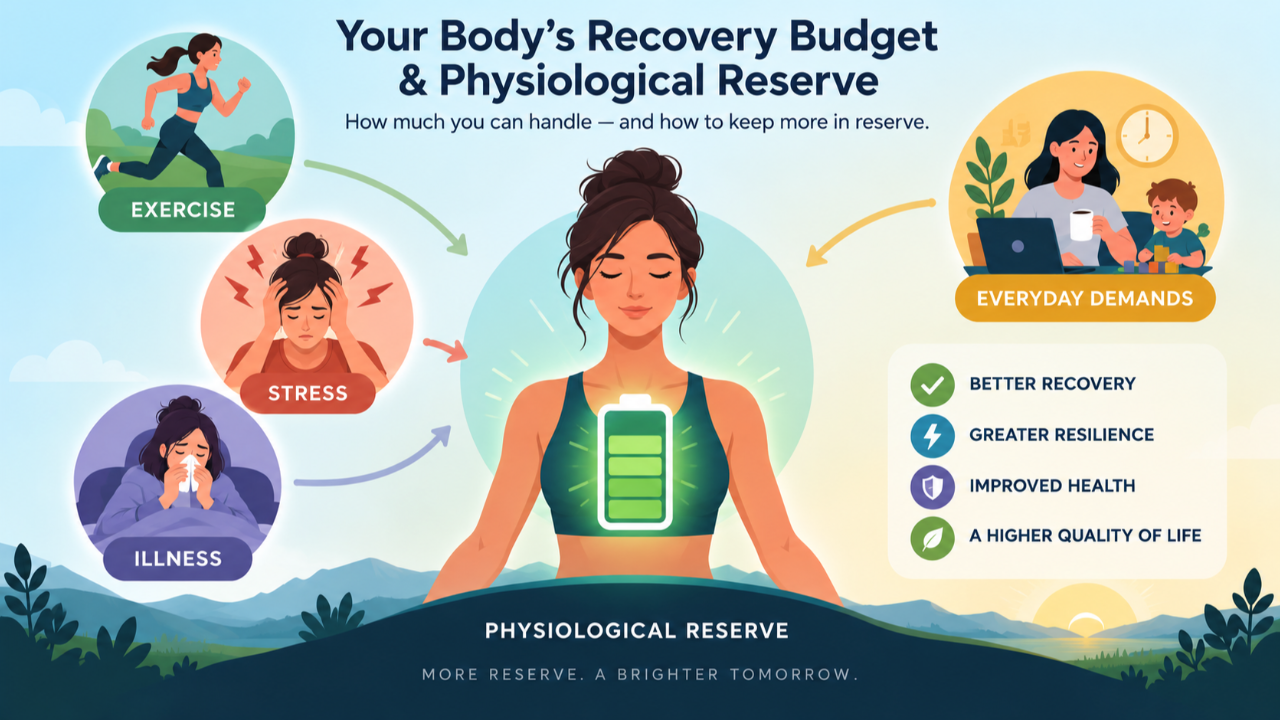
Have you ever noticed that something your body handled easily in the past suddenly feels harder?
Maybe a workout that once left you pleasantly tired now leaves you sore for several days. A busy week that you previously managed without much thought feels exhausting. Travel takes longer to recover from. You catch an illness and don't seem to bounce back as quickly. Or perhaps you simply notice that your capacity isn't as predictable as it once was.
It can be tempting to interpret these changes as a sign that something is wrong or that you simply need to push harder. But there may be another way to think about what is happening.
Your body has a recovery budget.
Not a literal bank account, of course, but a limited pool of resources that must continually be allocated across everything your body is being asked to do. And unlike a financial budget, you don't get to decide consciously where most of those resources go.
Your physiology does that for you.
Understanding this concept can help explain why the same activity may feel manageable one week and overwhelming the next, and why recovery depends on much more than what happens immediately after a workout, stressful day, or illness.
Your Body Is Always Spending Resources
We tend to notice the obvious demands we place on the body. Exercise requires energy. Concentrating on a difficult project requires energy. Fighting an infection requires energy.
But much of your body's daily workload happens quietly in the background.
At this moment, your body is regulating temperature, maintaining blood pressure, circulating nutrients, monitoring for potential threats, repairing tissues, producing hormones, managing fluids and electrolytes, digesting food, supporting brain activity, replacing damaged cellular components, and coordinating thousands of chemical reactions.
None of these processes are free.
They require energy, nutrients, oxygen, signaling molecules, enzymes, and functioning cellular machinery. Even when you are sitting still, your body is actively maintaining the conditions necessary to keep you alive and functioning.
Now add the demands of daily life.
You walk, exercise, think, solve problems, digest meals, respond emotionally, interact with other people, adapt to changes in temperature, encounter environmental exposures, and perhaps deal with an injury or infection.
The body must continually decide where resources are most needed.
This is one reason recovery is not simply something that happens when we stop moving. As we discussed last week, recovery is active biological work. But that work must occur alongside all the other work your body is already doing.
And sometimes those needs compete.
When Demands Begin to Compete
Imagine that you complete a challenging strength workout.
If you've been sleeping well, eating adequately, and moving regularly, and life is relatively stable, your body may have plenty of capacity available to respond to that challenge. The workout creates a demand, resources are directed toward recovery and adaptation, and you move on.
Now imagine the exact same workout during a very different week.
You've slept poorly for three nights. Work has been unusually demanding. You've skipped a few meals or haven't eaten enough protein. You're worried about someone you love. Your blood sugar has been swinging throughout the day, and your immune system may even be quietly responding to a virus you don't yet know you've encountered.
The workout hasn't changed.
But the environment in which your body receives that workout has.
Instead of being the primary challenge requiring resources, exercise has become one more demand added to an already crowded physiological workload.
This is the concept of competing demands.
The body doesn't experience exercise in one compartment, emotional stress in another, poor sleep somewhere else, and illness in yet another. These experiences may originate from very different places, but eventually they converge on shared physiological resources and regulatory systems.
That changes how much capacity remains available for recovery.
The Body Responds to the Whole Environment
We often evaluate health behaviors individually.
Was the workout healthy?
Was the meal healthy?
Did I get enough exercise?
Did I sleep enough?
Those questions can certainly be useful, but they don't always tell us how the body will respond.
A five-mile hike might be an appropriate challenge for one person and far too much for another. It could even be an appropriate challenge for the same person on Saturday and too much the following Wednesday.
The activity hasn't necessarily become "good" or "bad." The available capacity surrounding it has changed.
This is an important part of thinking about health through the lens of the body's terrain:
The body responds to the total environment, not one behavior in isolation.
That environment includes what we eat, how we sleep, how much we move, our metabolic health, immune activity, emotional demands, relationships, environmental exposures, and countless other signals.
This doesn't mean we need to track every possible variable or attempt to create perfect conditions before challenging ourselves. Quite the opposite.
It means context matters.
Your Recovery Budget Isn't Fixed
Here's where the budget analogy becomes particularly useful.
Imagine having $100 available and receiving a $20 expense. Easy enough.
But if $90 is already committed elsewhere, that same $20 expense suddenly matters much more.
Something similar can happen physiologically.
Your available capacity changes depending upon what your body is already managing. During periods of good health and adequate recovery, there may be considerable room for additional challenges. During illness, prolonged sleep disruption, major emotional strain, inadequate nutrition, or other periods of increased demand, that margin may shrink.
This may help explain why you occasionally think: "Why can't I handle this? I've done much harder things before."
The better comparison may not be between today's activity and what you did previously.
The better comparison may be between everything your body was managing then and everything it is managing now.
That's a very different question.
This Is Where Physiological Reserve Matters
Last month, we explored physiological reserve: the capacity your body has available to respond when demands increase.
Reserve gives you margin.
Someone with greater reserve generally has more resources available when an unexpected demand appears. That doesn't make a person invulnerable to stress, illness, injury, or fatigue. It simply means there may be more capacity available before demands begin to overwhelm the body's ability to respond effectively.
And reserve isn't one thing.
Muscle provides physical and metabolic capacity. Healthy mitochondria help cells meet changing energy requirements. Adequate nutrition supplies the raw materials necessary for repair and cellular function. Metabolic flexibility helps the body respond to changing fuel needs. Restorative sleep creates important opportunities for maintenance and regulation.
Relationships and social connection can also influence how demanding life feels physiologically, while a flexible nervous system helps us shift appropriately between activation and restoration.
Each contributes something different to the body's ability to meet changing circumstances.
Together, they help determine the size and flexibility of your physiological "budget."
Recovery and Reserve Work Together
This brings us to an important relationship between two ideas we've explored over the past several weeks:
Reserve supports recovery, and recovery helps preserve and build reserve.
When you have adequate reserve, your body has greater capacity to respond to challenges and perform the work of recovery.
When recovery occurs consistently, it helps restore resources, maintain healthy tissues, support metabolic function, and prepare the body for future demands.
Over time, this creates a reinforcing cycle.
Challenge draws upon reserve. Recovery restores and, when the challenge is appropriate, may help expand capacity. Greater capacity then provides more room for future challenges.
But when demands repeatedly accumulate without sufficient opportunity or resources for recovery, the opposite can occur. The margin becomes smaller.
This doesn't necessarily happen because one particular stressor is enormous. Sometimes it is simply the accumulation of many ordinary demands drawing from the same limited pool.
Sometimes the Answer Isn't to Push Harder
When our capacity changes, our instinct is often to focus on the thing we can no longer do as easily.
Why am I so tired after exercising?
Why am I having trouble concentrating?
Why am I not bouncing back?
Why does everything seem harder lately?
We may respond by pushing harder, adding another health strategy, or becoming frustrated with ourselves.
But looking at recovery through the lens of competing demands invites curiosity instead.
Perhaps the workout isn't the entire issue.
Perhaps your body is also allocating resources toward poor sleep, an infection, emotional strain, inadequate fueling, inflammation, caregiving responsibilities, environmental demands, or simply a season of life that requires more from you than usual.
This doesn't mean avoiding challenge. Challenge is necessary for adaptation and resilience.
It means recognizing that our capacity for challenge is dynamic.
There are times when adding an appropriate challenge helps build reserve. There are also times when reducing a demand, restoring a resource, or creating more opportunity for recovery may be the more productive choice.
Knowing the difference is part of learning to work with your physiology rather than continually asking it for more.
A Different Question to Ask
Your body isn't failing simply because today's capacity looks different from yesterday's.
Capacity changes because the demands placed upon us change, the resources available to us change, and our physiology is continually adjusting to both.
So the next time you find yourself wondering: "Why can't I handle what I used to?"
Try asking a different question: "What other demands might my body already be trying to manage?"
That question shifts the focus away from one behavior and toward the bigger picture.
And sometimes, seeing that bigger picture is exactly what helps us understand what our body needs in order to recover, adapt, and become more resilient again.
If you are interested in more information, schedule a free Discovery Call.
Let's stay connected!
Join my free Terrain Wellness Community
or sign up for my mailing list to receive the latest news and updates.
I will never sell your information, for any reason.
