
Why Blood Sugar May Be One of Your Most Powerful Hormone Regulators
foundations of healing lifetsyle & daily support metabolic health & cancer Jul 07, 2026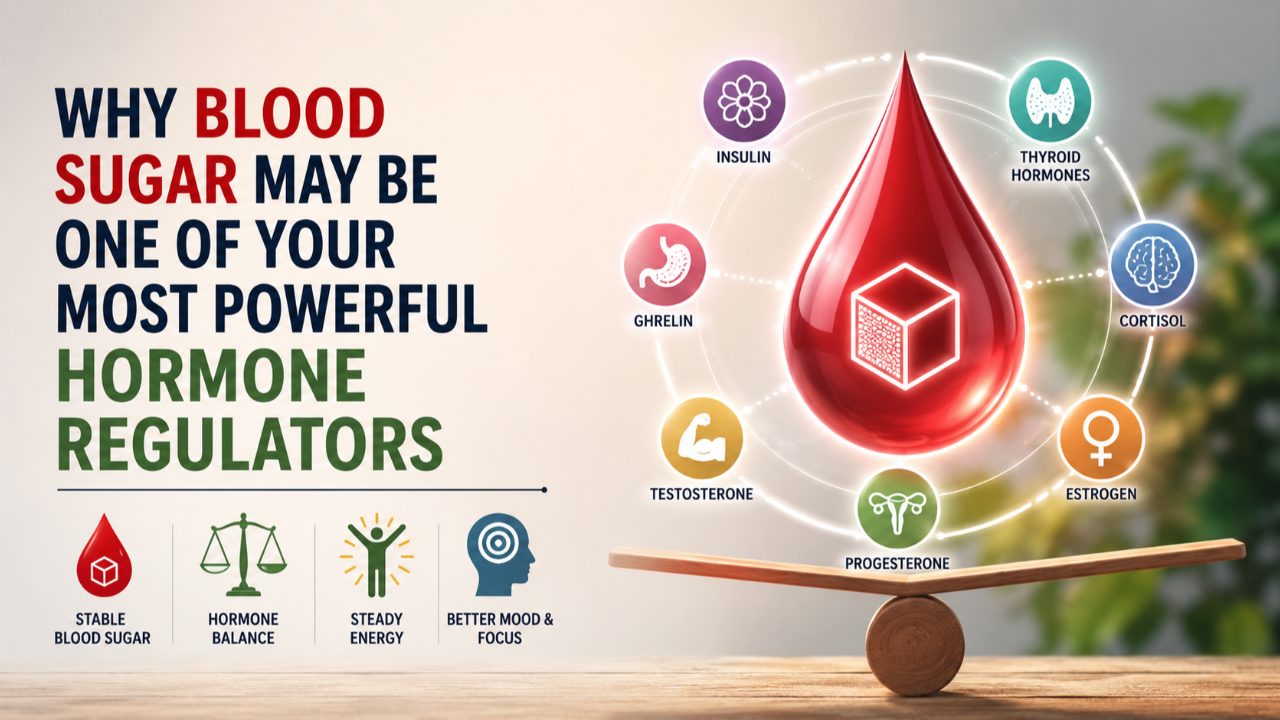
If you've ever struggled with fatigue, cravings, mood swings, stubborn weight gain, poor sleep, or changing hormones, you've probably been told to "balance your hormones."
But what if hormones aren't the place to start?
Last week we explored the idea that hormones are messengers. They carry information throughout the body, helping coordinate thousands of functions every second. Like any communication system, though, the quality of the message depends on the environment in which it travels.
One of the most important influences on that communication is something many people don't immediately associate with hormones: Blood sugar.
Most people think about blood sugar only in relation to diabetes. Yet every day, your blood glucose influences the activity of nearly every hormonal system in your body including cortisol, thyroid hormones, estrogen, progesterone, testosterone, leptin, ghrelin, and growth hormone.
Rather than viewing insulin simply as the hormone that lowers blood sugar, it's more accurate to think of it as one of the body's master communication hormones.
Let's explore why.
Insulin: More Than a Blood Sugar Hormone
Every time you eat, your body gathers information.
How much energy arrived?
How quickly did it arrive?
How much protein was included?
How much fat?
Will more food likely be available soon?
Insulin helps interpret those signals.
Its job extends far beyond moving glucose from the bloodstream into cells. Insulin also helps determine whether the body should:
- Store energy
- Burn stored fuel
- Build muscle
- Repair tissues
- Support reproduction
- Increase or decrease inflammation
- Produce other hormones
In many ways, insulin acts like a metabolic traffic controller.
When insulin signaling is working well, energy flows efficiently and other hormone systems tend to communicate more clearly.
Hormones Need Reliable Energy
Every cell in your body requires energy to function.
That includes the cells responsible for making hormones.
The thyroid depends on adequate energy to regulate metabolism.
The adrenal glands need energy to respond appropriately to stress.
The ovaries rely on sufficient energy availability to support normal reproductive function.
Even the brain, which serves as the master coordinator of the endocrine system, is highly sensitive to changes in glucose availability.
This is one reason why blood sugar instability can affect so many different symptoms simultaneously.
The issue isn't simply that glucose rises or falls.
It's that the body begins shifting into survival mode.
It's Not Just High Blood Sugar That Matters
Most conversations focus on elevated blood sugar.
But blood sugar variability may be just as important.
Two people can have the exact same average glucose level while experiencing very different daily patterns.
One person's glucose remains relatively steady.
The other's swings dramatically throughout the day.
Those repeated highs and lows require the body to continually adapt, increasing hormonal demands even when laboratory values still appear "normal."
Many people experience symptoms long before fasting glucose or hemoglobin A1c become abnormal.
Some common signs of blood sugar variability include:
- Feeling shaky when meals are delayed
- Needing sweets after meals
- Afternoon energy crashes
- Brain fog
- Irritability when hungry
- Waking during the night hungry
- Feeling energized immediately after sugar but crashing shortly afterward
These patterns provide valuable clues about how your body is managing energy.
When Blood Sugar Drops Too Low
Most people have heard of high blood sugar.
Fewer recognize how challenging reactive hypoglycemia can be.
This occurs when blood sugar falls rapidly after eating.
To protect the brain, the body quickly activates stress hormones including:
- Cortisol
- Epinephrine (adrenaline)
- Glucagon
These hormones help raise blood sugar again.
In an emergency, this response is incredibly helpful.
But when it happens repeatedly, your body spends more time managing energy crises than supporting long-term repair and recovery.
Many people mistake these episodes for anxiety.
Others simply describe feeling "hangry."
Often it's neither poor willpower nor personality.
It's physiology.
Hormonal Flexibility: The Ability to Adapt
One concept that receives far less attention is hormonal flexibility.
Healthy bodies don't keep insulin at one constant level.
Instead, insulin rises when needed and returns to baseline efficiently once its job is complete.
This ability to adapt is a hallmark of metabolic health.
When metabolic flexibility decreases, insulin often remains elevated longer than necessary or the body becomes less responsive to insulin's signals.
The result isn't simply altered blood sugar.
It can influence many other hormone systems.
For women especially, insulin resistance has been associated with changes in ovarian hormone production, increased androgen production, altered ovulation, and conditions such as polyendocrine metabolic ovarian syndrome (PMOS), formally called polycystic ovary syndrome (PCOS).
The goal isn't eliminating insulin.
The goal is restoring healthy responsiveness.
Hunger Hormones Are Listening Too
Have you ever finished eating only to feel hungry again an hour later?
That doesn't always mean you lacked discipline.
Your hunger hormones are continuously interpreting metabolic information.
Two important players are:
Ghrelin - often called the "hunger hormone," which stimulates appetite.
Leptin - produced primarily by fat tissue and helps communicate energy sufficiency to the brain.
Sleep quality, stress, inflammation, meal composition, insulin levels, and overall metabolic health all influence how these hormones function.
When communication becomes disrupted, appetite regulation becomes much more difficult.
Again, this isn't simply about eating less.
It's about improving the quality of the signals.
Cravings Are Often Messages
One of the biggest mindset shifts I encourage clients to make is this:
Curiosity before criticism.
Cravings are not always evidence of weak willpower.
Sometimes they reflect:
- Blood sugar fluctuations
- Inadequate protein intake
- Poor sleep
- Emotional stress
- Dehydration
- Mineral deficiencies
- Inadequate overall energy intake
- Habit or emotional associations
Instead of asking, "Why can't I control myself?"
Try asking, "What might my body be trying to tell me?"
That simple shift replaces shame with observation.
And observation creates opportunities for change.
Supporting Healthier Hormonal Communication
Supporting blood sugar doesn't require perfection.
It begins with creating a more stable metabolic environment.
Simple habits that often support steadier blood sugar include:
- Prioritizing adequate protein at meals
- Including healthy fats alongside protein to support satiety and provide a steadier fuel source
- Choosing carbohydrates intentionally based on your activity level and metabolic health rather than eliminating them out of fear
- Avoiding long periods of under-eating followed by overeating
- Building muscle through regular resistance exercise to improve glucose uptake
- Prioritizing restorative sleep
- Managing chronic stress, which can significantly influence glucose regulation
- Taking a short walk after meals to support glucose disposal
- Paying attention to how different meals affect your energy rather than relying solely on calorie counts
These habits don't just support blood sugar.
They help create an internal terrain where hormonal communication becomes more efficient.
Looking Beyond Individual Hormones
It's tempting to search for the one hormone responsible for how we feel.
But the body rarely works that way.
Hormones are part of an interconnected network, and blood sugar serves as one of the central signals influencing that network.
When we improve the way the body manages energy, many hormone systems benefit together.
That's why, from a metabolic perspective, we don't simply chase hormone numbers.
We support the environment that allows hormones to communicate effectively.
Because healthier communication leads to healthier function.
Final Thoughts
Hormones don't operate in isolation.
They respond to the metabolic environment you create every day.
Stable blood sugar isn't about achieving perfection or fearing every carbohydrate. It's about giving your body a steady, reliable supply of energy so it can communicate, adapt, and recover more effectively.
The next time you experience a craving, an energy crash, or a sudden mood shift, consider it an invitation to pause and ask what your body might be trying to tell you.
Sometimes the most powerful step toward better hormone health isn't changing your hormones at all.
It's supporting the terrain they depend on.
If you are interested in more information, schedule a free Discovery Call.
Let's stay connected!
Join my free Terrain Wellness Community
or sign up for my mailing list to receive the latest news and updates.
I will never sell your information, for any reason.
