
When Recovery Falls Behind: The Difference Between Being Tired and Being Under-Recovered
Sep 15, 2026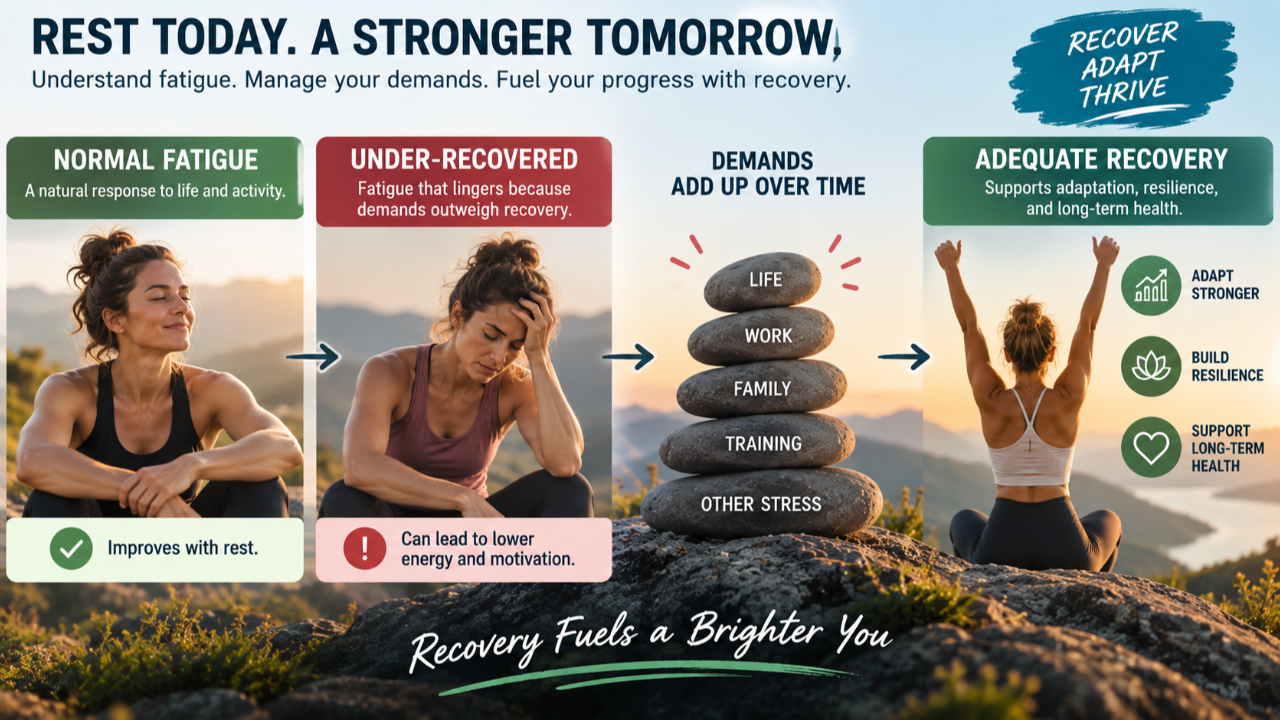
Feeling tired after a demanding day, sore after a workout, or mentally drained after a stressful week doesn't necessarily mean something is wrong. In fact, temporary fatigue is often a normal response to challenge.
We use resources when we exercise. Concentrated mental work requires energy. Emotional stress can keep multiple physiological systems engaged. Illness, travel, disrupted routines, poor sleep, and even positive experiences can temporarily increase what we're asking of the body.
Ideally, those periods of increased demand are followed by enough recovery for the body to replenish resources, repair what needs attention, and move back toward balance.
But what happens when the next demand arrives before that process is complete?
That's where being under-recovered can look quite different from simply being tired.
Being Tired Isn't Necessarily the Problem
Fatigue is often treated as something we should eliminate. But fatigue can also be useful information.
After a challenging workout, your muscles may feel tired because you've asked them to do more than usual. After a long day requiring sustained concentration, your brain may be ready for a break. Following an illness, your energy may temporarily be directed toward immune activity and repair.
In these situations, feeling tired can be part of an appropriate response to increased demand.
The more useful question isn't: "Am I tired?"
It's: "Am I recovering from what I'm asking my body to do?"
If the answer is yes, fatigue often improves as recovery catches up with demand.
The concern is less about an occasional period of tiredness and more about what happens when the body repeatedly has less recovery time than the demands placed upon it require.
Recovery Happens Between the Challenges
Think about a simple pattern:
Demand → Recovery → Demand → Recovery
A challenge occurs. The body responds. Recovery follows. Resources are replenished, tissues are repaired, physiological systems recalibrate, and you're better prepared for the next challenge.
This is one reason appropriate challenges can actually make us stronger. Exercise is perhaps the easiest example. The workout provides the stimulus, but the adaptation occurs afterward.
Now imagine a different pattern:
Demand → Partial Recovery → Demand → Partial Recovery → Demand
The individual demands may not be extraordinary. The problem is that recovery never quite catches up.
Perhaps you exercise after several nights of shortened sleep. Then a stressful work deadline arrives. Meals become rushed or irregular. You spend a weekend traveling and return home to another busy week.
None of those experiences necessarily represents a major health threat on its own. But the body doesn't experience life in neatly separated categories.
Your Body Doesn't Keep Separate Calendars
We often mentally divide our stressors into different compartments.
There's exercise.
There's work.
There's family.
There's sleep.
There's illness.
There's travel.
There's emotional stress.
There's nutrition.
But physiologically, these demand overlap.
A hard workout doesn't occur in isolation from the poor night's sleep that came before it. A stressful conversation doesn't happen independently of the work deadline you've been managing all week. A disrupted night of sleep may affect how well you tolerate the physical and cognitive demands of the following day.
The body is continually allocating resources in response to the total environment it encounters.
This helps explain why something you normally tolerate well may occasionally feel much harder. The workout hasn't necessarily changed. The demands surrounding it may have.
The Accumulation Effect
Imagine that each challenge temporarily moves you away from your usual baseline. With adequate recovery, you gradually move back toward that baseline before the next significant challenge arrives.
But if another demand arrives while recovery is still underway, you begin the next challenge from a slightly different starting point.
Then it happens again.
And again.
The gap between what you're asking of your body and what it has had an opportunity to restore can gradually widen.
This doesn't necessarily happen dramatically. In fact, it may be subtle enough that we simply adjust to feeling a little more tired, a little less motivated, or a little less capable than we once did.
We may respond by pushing harder.
More caffeine.
More intense workouts.
More productivity.
Less downtime.
Or we may assume that we've suddenly lost discipline or motivation.
Sometimes, however, the better question is not "Why can't I do more?"
It may be: "Have I fully recovered from what I've already been doing?"
When Ordinary Demands Begin to Feel Bigger
One of the more useful clues that recovery deserves attention may be a change in how we respond to familiar demands.
A workout that was previously manageable feels unusually difficult.
Normal muscle soreness lingers longer than expected.
A full night's sleep doesn't feel particularly restorative.
Concentrating requires more effort.
Small inconveniences feel disproportionately frustrating.
Motivation for activities you normally enjoy begins to decline.
These experiences don't automatically mean you're under-recovered. Persistent fatigue, sleep changes, exercise intolerance, difficulty concentrating, irritability, and other changes can have many possible causes. New, persistent, worsening, or unexplained symptoms deserve appropriate medical evaluation rather than being attributed solely to stress or inadequate recovery.
But they can also be useful prompts to look at the broader pattern. Rather than focusing on one symptom, consider what has been happening over time.
Has demand increased?
Has sleep changed?
Have you been recovering from an illness?
Has your exercise volume or intensity increased?
Has emotional or cognitive stress been unusually high?
Have routines that normally support you fallen away?
Sometimes the individual pieces don't look particularly significant until we step back and see them together.
Recovery Is Dynamic
One reason recovery can be difficult to judge is that our capacity isn't exactly the same every day. You may tolerate a demanding workout beautifully one week and struggle with the same workout another week.
That doesn't necessarily mean you've become less fit.
The second workout may be occurring against a very different physiological backdrop.
Perhaps you've slept poorly for several nights. Maybe you've recently traveled, fought off an infection, experienced significant emotional stress, or simply had an unusually demanding schedule.
The workout may be the same, but the starting point isn't.
This is why recovery isn't something we can determine from a rigid formula. It requires paying attention to context.
The goal isn't to constantly monitor every sensation or become fearful of normal fatigue. It's to become better at noticing patterns.
More Recovery Doesn't Always Mean Doing Less
This distinction matters.
If we hear that stress and inadequate recovery can affect health, it's easy to conclude that the solution is to avoid challenge. But challenge is essential to adaptation.
Muscles become stronger because we load them.
Cardiovascular fitness improves because we challenge the heart and lungs.
Our brains learn because we ask them to solve problems and acquire new skills.
Even psychological resilience can grow through navigating manageable difficulty.
The goal isn't a life without stress.
It's a life in which challenge and recovery work together.
Sometimes improving recovery may mean taking a rest day. But it can also mean going to bed earlier, eating enough to support activity, changing the intensity of a workout, taking a walk instead of remaining sedentary after a stressful day, spending time outside, reconnecting with someone you care about, or simply creating periods when your nervous system isn't being asked to respond to another incoming demand.
Recovery doesn't necessarily require stopping.
Sometimes it requires changing what you're asking of the body.
A Better Question to Ask
We tend to evaluate our health behaviors individually.
Did I exercise today?
Did I eat well?
Did I sleep enough?
Did I manage my stress?
Those questions have value, but recovery asks us to look at the relationship between them.
Instead of asking only whether you're doing the "right" things, occasionally step back and ask: "Does the recovery in my life match the demands in my life right now?"
The answer won't always be yes.
There will be demanding seasons. Travel happens. Sleep gets disrupted. Illness occurs. Families need us. Work becomes stressful. Life rarely provides a perfectly balanced schedule.
The goal isn't perfection.
It's recognizing when the balance has shifted for long enough that recovery deserves more attention.
Recovery Creates the Space for Adaptation
Being temporarily tired isn't necessarily a sign that you've done too much. Sometimes it simply means you've done something that required effort.
The important part is what happens next.
Challenge provides the stimulus.
Recovery provides the opportunity to respond to that stimulus.
And over time, that cycle helps build the capacity to handle future demands.
Recovery isn't about avoiding challenge. It's about creating enough space between challenges for adaptation to occur.
Instead of asking how to eliminate every source of stress from your life, consider a different question: "Where might I need to create a little more room for recovery?"
That small shift from avoiding stress to supporting recovery can change the way we think about resilience altogether.
If you are interested in more information, schedule a free Discovery Call.
Let's stay connected!
Join my free Terrain Wellness Community
or sign up for my mailing list to receive the latest news and updates.
I will never sell your information, for any reason.
