
The Recovery Gap: When Life Moves Faster Than Your Body
Oct 13, 2026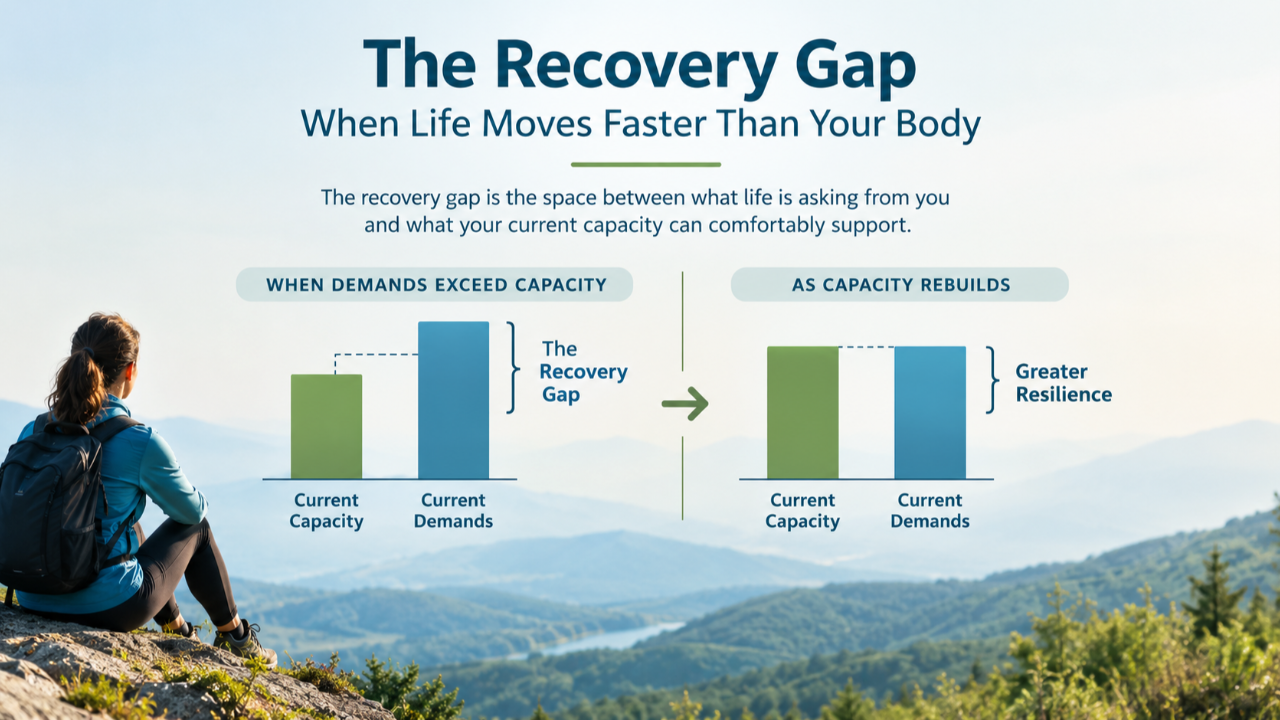
Have you ever noticed that just when you start feeling better, life seems to pick up speed again?
You begin having more good days. Your energy improves, everyday tasks feel easier, and you finally start recognizing the person you were before your health challenges began. Naturally, you want to get back to doing the things you've missed.
You return to work, increase your exercise, make plans with friends, take on household projects, or resume responsibilities that have been waiting for your attention.
At first, everything seems to be going well. But then something changes. You're more exhausted than expected, your concentration begins to fade, or you find yourself needing an entire day to recover from activities that once required very little effort.
You thought you were getting better. So why does it suddenly feel like you're moving backward?
You may be experiencing what I call the Recovery Gap.
What Is the Recovery Gap?
The Recovery Gap is the space between what life is asking from you and what your current capacity can comfortably support.
Following an illness, injury, surgery, medical treatment, or prolonged period of stress, your body's ability to meet physical, mental, and emotional demands may be different from what it was before.
Although symptoms may be improving, that doesn't necessarily mean every system involved in supporting your daily activities has returned to its previous level of function.
Your energy production, muscular endurance, nervous system regulation, cognitive stamina, and ability to respond to stress may still be rebuilding.
Meanwhile, life doesn't necessarily slow down to accommodate that process.
Work deadlines return. Family responsibilities continue. Social invitations arrive. There are appointments to attend, errands to run, and people depending on you.
The demands of everyday life can return much faster than your capacity to manage them.
WHEN DEMANDS EXCEED CAPACITY
Current Capacity < Current Demands
The Recovery Gap
AS CAPACITY REBUILDS
Current Capacity ≈ Current Demands
A More Sustainable Balance
These relationships are a way of understanding recovery, not a precise medical measurement. The goal isn't to make life completely free of demands. It's to recognize when those demands may be consistently exceeding your current resources.
And perhaps most importantly, a Recovery Gap doesn't automatically mean you're doing something wrong. It may simply mean that your expectations, responsibilities, and current capacity haven't caught up with one another yet.
Why We Rush Back Before We're Ready
Most people don't intentionally push beyond their capacity. In fact, the desire to resume normal activities is often a positive sign that they're beginning to feel better.
But several powerful influences can make this stage of recovery particularly challenging.
1. Feeling better creates a sense of freedom
After weeks or months of limitations, even a small improvement can feel tremendous. You may finally have enough energy to go for a walk, spend time with friends, or accomplish something you've been putting off.
The temptation is to make up for lost time. Instead of gradually increasing activities, you try to fit everything you've missed into the first few days you're feeling better.
Unfortunately, feeling capable of doing something today doesn't always tell you how well your body will respond afterward.
2. Responsibilities don't disappear during recovery
Many people don't have the luxury of waiting until they feel completely recovered before returning to their responsibilities.
Bills still need to be paid, children need attention, aging parents need assistance, and employers have expectations. Sometimes the demands placed on us aren't optional.
This is an important distinction because conversations about recovery can unintentionally suggest that people simply need to rest more or do less. For many, that isn't a realistic solution.
Instead, understanding the Recovery Gap can help identify where adjustments might be possible, even when major responsibilities cannot be eliminated.
3. We compare ourselves to who we used to be
Perhaps you previously walked five miles without thinking twice, worked a full day and still had energy for an evening workout, or managed a busy household without feeling overwhelmed.
Those experiences become your reference point for what you believe you should be able to do.
But your previous capacity and your current capacity aren't necessarily the same.
Continuously measuring today's abilities against yesterday's expectations can create frustration, particularly when progress isn't happening as quickly as you'd hoped.
4. Other people assume we're fine
When someone looks healthier, returns to work, or begins participating in social activities again, others may assume recovery is complete.
Comments such as "You look great!" or "It's wonderful that you're back to normal!" are usually well-intentioned. Yet they can create pressure to meet expectations that don't reflect how someone is actually functioning.
And sometimes the greatest pressure comes from ourselves. We don't want to disappoint others, appear incapable, or admit that we still have limitations.
What Does the Recovery Gap Look Like in Everyday Life?
The Recovery Gap doesn't always announce itself through obvious symptoms. Sometimes it appears as a subtle change in how you respond to activities that were once routine.
You might recognize it in situations like these:
-
The good-day, bad-day cycle: You feel productive for several days, accomplish more than usual, and then find yourself unusually depleted afterward.
-
Exercise feels different: A workout that previously left you energized now results in disproportionate fatigue or requires much longer recovery.
-
Your mental energy fades: You can concentrate effectively in the morning, but by late afternoon even simple decisions seem difficult.
-
Social activities become exhausting: You enjoy spending time with family or friends, yet need considerable downtime afterward.
-
There's little energy left for enjoyment: You manage work, household responsibilities, and other necessities, but have very little capacity remaining for hobbies, relationships, or activities that bring you joy.
One particularly frustrating aspect of this experience is that you may be capable of completing an activity without yet having the capacity to recover from it efficiently.
Those are two different things.
Being able to get through a busy day doesn't necessarily mean that the demands of that day were well matched to your current resources.
Of course, persistent or worsening fatigue, exercise intolerance, cognitive changes, or other symptoms shouldn't automatically be attributed to a Recovery Gap. They may have medical causes that deserve further evaluation, particularly following significant illness or treatment.
The Goal Isn't to Avoid Stress or Activity
Here's where understanding the Recovery Gap becomes especially important.
If exceeding our current capacity can contribute to setbacks, does that mean we should avoid challenging ourselves?
Absolutely not.
Throughout my recent blog series, we've explored how the body adapts to challenges and why appropriate stress is an essential part of building strength and resilience.
Our muscles become stronger when they're challenged. Our cardiovascular system adapts to increasing demands. Even our ability to manage everyday stressors can improve through experience and appropriate recovery.
Challenge is necessary for adaptation, but challenge and recovery need to work together.
Consider someone returning to exercise after an extended illness.
If they avoid all meaningful activity, they may miss opportunities to rebuild strength and endurance. But if they immediately return to their previous training intensity, the demands may exceed what their current system can tolerate.
A more effective approach often involves beginning at an appropriate level, observing the response, allowing adequate recovery, and gradually increasing the challenge as capacity improves.
This principle extends beyond exercise.
Returning to work, managing social commitments, traveling, and taking on emotionally demanding responsibilities can all require a similar process of adjustment.
The goal isn't to eliminate demands. It's to find a level of challenge that supports adaptation without repeatedly overwhelming the resources available for recovery.
For people experiencing significant post-exertional symptom worsening, such as post-exertional malaise associated with some chronic conditions, even small increases in activity may cause prolonged setbacks. In those circumstances, conventional graded increases may be inappropriate, and activity should be guided by individual tolerance and knowledgeable medical care.
Closing the Recovery Gap: A Different Way to Think About Progress
When you recognize a gap between your demands and your current capacity, the instinctive response may be to ask: "How can I get back to doing everything I used to do?"
But perhaps a more useful question is: "How can I create the conditions that allow my capacity to rebuild?"
That shift changes how we approach recovery.
Instead of viewing every limitation as something to overcome immediately, we begin looking at the relationship between what we're asking of our bodies and what they currently have available.
There are several ways to begin thinking about that relationship.
Recognize your current starting point. Your capacity today is information, not a judgment about your determination or potential. Understanding what you can comfortably manage provides a more useful starting point than relying solely on what you could do before your health challenge.
Consider the total demands of your day. Physical activity is only one part of the picture. Work, emotional stress, caregiving, cognitive demands, disrupted sleep, and ongoing health concerns can all influence how much you have available for other activities.
Pay attention to your response, not just your performance. Completing an activity tells you what you were able to do. How you feel later that day and over the following days may provide additional information about how well that demand matched your current capacity.
Allow room for gradual adaptation. Progress doesn't always require dramatic changes. Sometimes it's the consistent, manageable challenges, followed by adequate recovery, that help build greater capacity over time.
And remember, recovery isn't always linear. There may be periods when your capacity improves, times when it temporarily declines, and circumstances that require you to adjust expectations.
That doesn't erase the progress you've already made.
The Role of Thought Work in the Recovery Gap
There's another important part of this conversation that often gets overlooked: the way we think about our recovery.
Imagine two people experiencing the same limitation.
One thinks, "I should be able to do more by now. I'm falling behind."
The other thinks, "My capacity is still rebuilding. What can I do today that supports where I want to go?"
Neither thought changes the person's physical capacity in that moment. But each can influence how they interpret their experience and what they choose to do next.
The first thought may create frustration, comparison, or pressure to push beyond what feels manageable. The second creates an opportunity for curiosity, problem-solving, and more intentional decisions.
This is what I refer to as thought work: learning to recognize the thoughts influencing our emotions, choices, and behaviors, and questioning whether those thoughts are helping us move toward our goals.
Thought work doesn't mean pretending limitations don't exist or believing we can think our way out of a physical health challenge.
It means recognizing that while we may not always control our circumstances or how quickly our bodies recover, we can examine the expectations and interpretations we bring to that experience.
Sometimes changing the way we think about recovery can help us make choices that better support it.
Recovery Isn't About Getting Your Old Life Back Overnight
One of the challenges of recovering after a health event is that the world around us may return to its usual pace long before we feel ready to keep up.
And because progress is often measured by what we can accomplish, it's easy to overlook the work our bodies may still be doing behind the scenes.
But rebuilding capacity takes time. It requires appropriate challenges, sufficient resources, opportunities for recovery, and a willingness to adjust along the way.
The Recovery Gap gives us a different way to understand those moments when our expectations and our abilities don't quite match.
Rather than automatically interpreting those experiences as failure, we can begin asking whether the demands of our lives are aligned with our current capacity.
The goal isn't to keep your world small to avoid exceeding your limits. It's to progressively build the capacity to participate more fully in the life you want to live.
And sometimes the most productive step forward isn't doing more.
It's understanding what your body needs in order to be ready for more.
Continue Exploring Recovery with Terrain Wellness
Understanding the Recovery Gap is one piece of a much larger picture. Recovery involves the interaction of energy production, adaptive capacity, sleep, nutrition, nervous system regulation, movement, and the everyday choices that influence how we respond to life's demands.
These connections are central to my upcoming educational course, Recover to Thrive: A Metabolic Approach to Building Health and Resilience.
In this course, we'll explore the science behind recovery, what influences our ability to adapt, and how to apply that understanding to support long-term health and resilience.
My goal is to help you move beyond simply trying to do more and begin understanding how to create the conditions that support your body's ability to respond, recover, and adapt.
In the meantime, I invite you to consider one question: Where in your life might the demands you're placing on yourself be moving faster than your current capacity to recover?
Sometimes recognizing that gap is the first step toward making meaningful changes.
If you are interested in more information, schedule a free Discovery Call.
Let's stay connected!
Join my free Terrain Wellness Community
or sign up for my mailing list to receive the latest news and updates.
I will never sell your information, for any reason.
