The Five Foundations of Recovery: What Helps the Body Rebuild
Sep 22, 2026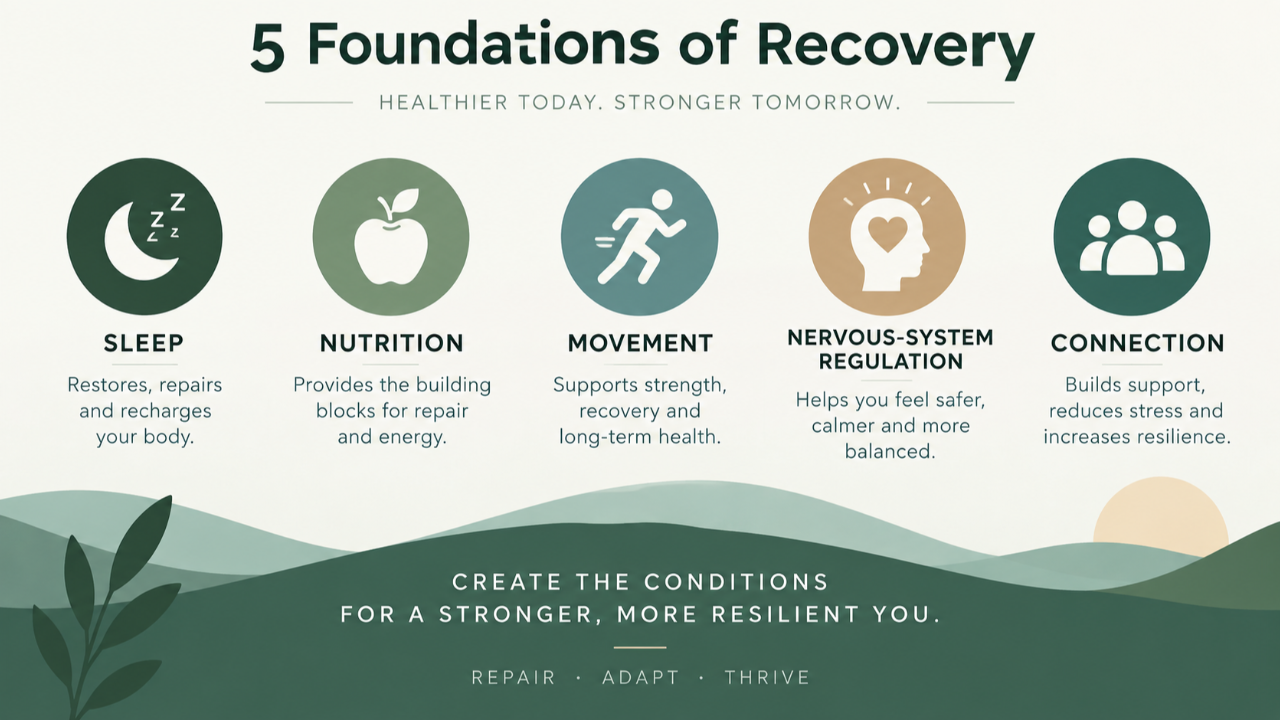
Over the past several weeks, we’ve explored recovery from a different perspective.
We’ve looked at recovery as an active biological process rather than simply “rest.” We’ve talked about the resources required to repair, restore, and adapt. And we’ve considered what can happen when the demands placed on the body repeatedly exceed its opportunity to recover.
All of that brings us to an important question: What actually helps the body recover?
Wellness advice can make the answer seem remarkably complicated. There is always another strategy to try, another metric to track, or another “hack” promising to optimize your health.
But recovery doesn’t necessarily require more complexity. Instead, it may be more useful to step back and look at the basic conditions the human body relies upon to do what it already knows how to do: restore, repair, regulate, and adapt.
While many factors influence recovery, five stand out as particularly important: sleep and circadian rhythm, nutrition and metabolic resources, movement, nervous-system regulation, and connection and meaning.
These aren't five isolated strategies. They continually interact with one another, creating the physiological environment in which recovery takes place.
1. Sleep and Circadian Rhythm: Giving Recovery a Time and Place
Sleep may be the first thing that comes to mind when we think about recovery and for good reason.
During sleep, the body isn't simply shutting down. Important processes associated with memory consolidation, immune regulation, hormonal signaling, tissue maintenance, and metabolic regulation continue behind the scenes.
But there is an important distinction: Supporting sleep begins long before your head hits the pillow.
Your body operates according to approximately 24-hour biological rhythms. Light exposure, darkness, activity, food intake, and regular routines all provide information that helps synchronize those rhythms.
Morning light tells the body that the biological day has begun. Daytime movement reinforces wakefulness and activity. Regular meal timing provides additional metabolic cues. As evening arrives, decreasing light and stimulation help signal a transition toward rest.
This means recovery isn't something we suddenly switch on at bedtime. The way we move through the entire day helps create the biological context for what happens at night.
Instead of thinking only about getting a certain number of hours of sleep, consider the broader question: What signals am I giving my body throughout the day about when it is time to be active and when it is time to recover?
2. Nutrition and Metabolic Resources: Supplying the Raw Materials
Repair requires resources.
Muscle tissue, enzymes, hormones, immune cells, neurotransmitters, connective tissue, and countless other structures don't appear out of thin air. The body continually needs energy and raw materials to maintain and rebuild itself.
Protein provides amino acids used throughout the body. Vitamins and minerals participate in thousands of biochemical reactions. Water is essential for circulation, temperature regulation, digestion, and cellular function. And sufficient energy availability matters because repair itself requires energy.
This is one reason nutrition and recovery are difficult to separate.
The conversation around food can easily become focused on rules: what to eliminate, what diet to follow, or which foods are supposedly “good” or “bad.” From a recovery perspective, there is another useful question to ask: Does my body consistently have the resources it needs to meet its demands?
For most people, that brings the focus back to fundamentals: nutrient-dense whole foods, adequate protein, hydration, sufficient energy, and eating patterns that support healthy metabolic signaling.
Nutrition isn't simply fuel for what you want your body to do.
It also helps supply what your body needs to rebuild afterward.
3. Movement: The Right Challenge at the Right Time
Movement occupies an interesting place in recovery because it can be both a demand on the body and something that supports the body's ability to recover.
Exercise temporarily creates physiological stress. Muscles are challenged. Energy is consumed. Signaling pathways are activated. The body then responds to that challenge during the recovery period that follows.
When appropriately matched to your current capacity, movement can support circulation, mitochondrial function, muscle maintenance, metabolic health, mobility, and nervous-system regulation.
But more isn't automatically better.
A hard workout layered onto inadequate sleep, illness, emotional stress, poor nutrition, or an already demanding week isn't the same physiological experience as that identical workout performed when your resources are plentiful.
The movement didn't necessarily change.
The context did.
This is where the idea of physiological reserve from our previous discussions becomes useful. Your ability to benefit from a challenge depends partly upon whether you have enough capacity to respond to it.
Sometimes the appropriate challenge may be strength training or vigorous exercise. At another time, it may be walking, mobility work, or simply getting outside and moving.
The goal isn't to maximize exercise. It is to provide an appropriate challenge and then allow enough recovery for adaptation to occur.
4. Nervous-System Regulation: Signaling That the Demand Has Passed
Not every demand placed on the body comes from exercise, illness, or physical exertion.
Our nervous system is continually gathering information from both inside and outside the body and adjusting physiology accordingly.
A demanding schedule, constant notifications, uncertainty, conflict, rushing from one obligation to another, or simply having very little uninterrupted downtime can contribute to an environment in which the body receives repeated signals that something still requires attention.
This doesn't mean stress is inherently harmful. As we've discussed before, the ability to respond to stress is part of being resilient.
The problem arises when activation becomes persistent and there are too few opportunities to shift out of it.
Recovery benefits from moments that communicate something different: The immediate demand has passed.
That signal may come from slow breathing, quiet, time outdoors, an enjoyable hobby, prayer or meditation, a predictable evening routine, listening to music, or simply having periods when you aren't consuming information or responding to someone else's needs.
There is no single technique everyone needs to practice. What matters is creating regular opportunities for the body to experience a change in state rather than remaining continually “on.”
5. Connection and Meaning: Recovery Is Not Entirely an Individual Process
We often talk about health as though it is something we build entirely by ourselves.
Eat well. Exercise. Sleep. Manage stress.
But humans are social organisms, and our relationships and environment are part of our biology too.
Supportive relationships can provide a sense of belonging, predictability, and safety. Laughter and enjoyable experiences can change our physiological state. Purpose gives us reasons to engage with life rather than simply trying to avoid illness. Meaningful activities can provide satisfaction and connection that no health tracker can measure.
This doesn't mean everyone needs a huge social network. Sometimes one or two relationships in which you feel genuinely supported may matter more than dozens of superficial connections.
Connection can also extend beyond people. Time with a pet, involvement in a community, spiritual practices, volunteering, creativity, meaningful work, or spending time in nature can all contribute to a larger sense of engagement and purpose.
Recovery isn't only about restoring cells and replenishing energy.
It is also about creating a life in which the body isn't continually being asked to function in isolation from the things that help us feel grounded, connected, and alive.
The Foundations Work Together
It is tempting to look at these five areas and immediately turn them into another checklist.
Eight hours of sleep.
Enough protein.
Exercise completed.
Breathing practice done.
Social connection scheduled.
But that misses the larger point.
These aren't five separate health hacks. Together, they create conditions that support recovery.
And they influence one another.
A walk outside may provide movement, daylight exposure, nervous-system regulation, and connection if you walk with someone you enjoy.
Eating a nourishing meal with people you care about may provide nutritional resources, social connection, enjoyment, and cues of safety.
A consistent evening routine may reduce stimulation, support circadian rhythm, and help the nervous system transition toward sleep.
Health doesn't occur in isolated categories. Neither does recovery.
You Don't Have to Optimize Everything
Perhaps one of the most useful things to understand about recovery is that supporting it doesn't require perfect behavior.
Your body doesn't need you to execute an elaborate wellness routine every day. It needs enough opportunity and enough resources to keep responding to the demands being placed upon it.
Some seasons of life will naturally require more from you. Illness, caregiving, emotional challenges, work demands, travel, disrupted sleep, or simply unexpected life events can temporarily increase the load.
During those times, recovery may not look like doing more. It may mean becoming more intentional about protecting the basics.
Instead of asking: “What else should I be doing for my health?”
Try asking: “What would help my body recover from what I am already asking it to do?”
That question changes the conversation. It moves us away from chasing the next health strategy and toward understanding what the body actually needs.
Creating the Conditions for Recovery
Throughout this month's series, we've looked at recovery as far more than taking a day off or getting extra sleep.
Recovery is part of the cycle through which the body responds to challenge:
Demand → Recovery → Adaptation → Greater Capacity
When recovery repeatedly falls short, that cycle can become harder to complete. But when the body has adequate resources and opportunity, challenge can become something we adapt to rather than something that continually depletes us.
Sleep and circadian rhythm provide biological timing.
Nutrition provides energy and raw materials.
Movement provides an appropriate stimulus.
Nervous-system regulation creates opportunities to shift out of ongoing activation.
Connection and meaning contribute to the environment in which all of this occurs.
None works completely alone.
Together, they help create the conditions in which the body's remarkable capacity to repair, regulate, and adapt can do its work.
And ultimately, that may be one of the most useful ways to think about recovery:
You don't have to force your body to recover.
You can help create the conditions that allow recovery to happen.
If you are interested in more information, schedule a free Discovery Call.
Let's stay connected!
Join my free Terrain Wellness Community
or sign up for my mailing list to receive the latest news and updates.
I will never sell your information, for any reason.
