
Recovery: The Missing Half of Building Resilience
Aug 25, 2026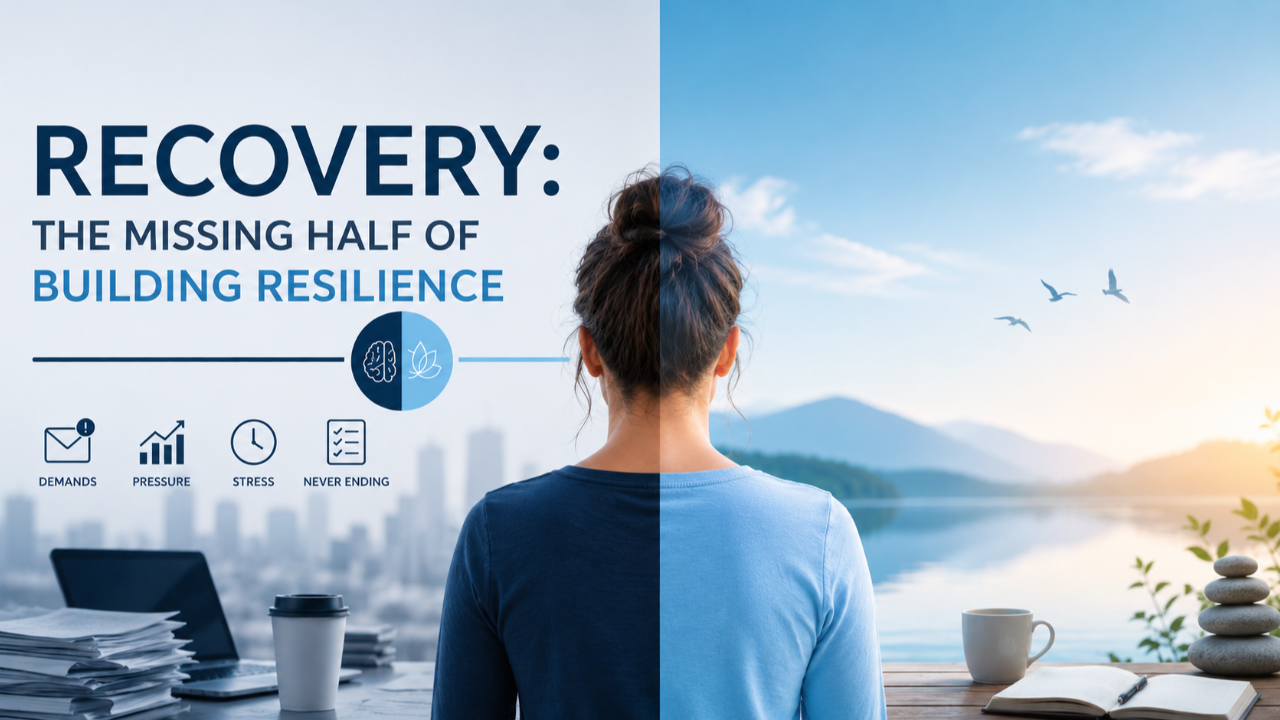
Over the past several weeks, we’ve explored stress from a different perspective.
We’ve talked about why not all stress is harmful, how the brain and body interpret challenges, how stress can come from sources we don’t always recognize, and why building greater physiological reserve can help us become more resilient.
All of that leads to an important question:
Where does recovery fit into the picture?
We often talk about health in terms of what we should do: exercise more, eat better, improve our sleep, reduce stress, spend time outside, maintain relationships, and make healthier choices. All of those things matter. But there is another part of the equation that receives far less attention.
The body also needs the opportunity and resources to respond to what we ask of it.
That is where recovery comes in.
Recovery isn’t simply taking a day off, getting more sleep, or relaxing after a difficult week. At a deeper level, recovery is part of the biological process that allows us to repair, replenish, reorganize, and adapt. And without that part of the process, simply doing more “healthy things” may not always produce the results we expect.
The Work Doesn't End When the Challenge Ends
Think about what happens when you exercise. During exercise, you are intentionally creating a challenge. Muscles are placed under load. Energy demand increases. Stored fuel is used. Cellular signals are generated that essentially tell the body:
We need to become better prepared to handle this again.
But the workout itself isn't when you become stronger. The workout provides the stimulus. What happens afterward determines how your body responds to that stimulus.
Given adequate time, energy, nutrients, sleep, and other supportive conditions, the body begins the work of rebuilding and adapting. Over time, that process can lead to stronger muscles, improved cardiovascular capacity, greater metabolic efficiency, and increased ability to tolerate future demands.
This basic principle extends well beyond exercise. Every day, your body is responding to physical, metabolic, cognitive, emotional, and environmental demands. Some are large and obvious. Others are small and barely noticeable.
Recovery is what happens between those demands.
It is the period in which the body has an opportunity to restore what was used, repair what was disrupted, and prepare for what may come next.
Recovery Is an Active Biological Process
We sometimes think of recovery as the absence of activity.
Work hard. Then stop.
Exercise. Then rest.
Have a stressful week. Then take the weekend off.
But biologically, recovery isn't an empty space where nothing is happening. Quite the opposite. Your body is continually performing maintenance.
Cells repair damage. Energy stores are replenished. Proteins are built and broken down. Immune activity is regulated. Tissues remodel. Metabolic signals shift. The nervous system adjusts. Information from the day's experiences is processed and integrated.
Much of this happens quietly, without our awareness. This is why I think it is helpful to stop viewing recovery simply as rest and begin viewing it as biological work.
You may be sitting still, but your body certainly isn't.
Stress + Recovery Creates the Opportunity for Adaptation
One of the themes we explored was that stress itself isn't always the enemy. Certain challenges can actually make us stronger.
Exercise is perhaps the easiest example, but the principle applies more broadly. The body is designed to encounter changing demands and respond to them. But challenge alone doesn't create resilience.
A more complete picture looks something like this:
Challenge → Recovery → Adaptation
Remove the challenge, and there may be little reason for the body to adapt. Remove adequate recovery, however, and repeated challenges may begin to exceed the body's ability to keep up.
That distinction matters. It shifts the question from: “How much stress am I experiencing?” to something more useful: “Do I have enough recovery capacity for the demands being placed on me?”
Those are not the same question.
Two people may experience similar demands yet respond very differently because their available resources, reserve, and opportunities for recovery are different.
Even within the same person, that balance can change from one season of life to another.
Your Capacity for Recovery Isn't Fixed
There are times when we can handle a great deal. A busy week, challenging workout, disrupted night of sleep, long trip, or emotionally demanding situation may temporarily knock us off balance, but we recover relatively quickly.
At other times, much smaller demands seem to take more out of us.
Why?
Because recovery does not occur in isolation. The body has to allocate resources across many competing needs.
Imagine having a daily biological budget. Energy and nutrients are needed for movement, immune function, digestion, temperature regulation, tissue repair, brain activity, hormone production, cellular maintenance, and countless other processes.
When demands increase, more of that budget may be required simply to keep everything running. That can leave less available for rebuilding and restoration.
This helps explain something many of us have experienced: the same challenge doesn't always affect us the same way.
A workout that feels energizing one week may feel exhausting another week. A hectic day that once seemed manageable may suddenly feel overwhelming. Travel may be easy at one point in life and require considerably more recovery at another.
The challenge hasn't necessarily changed. The context in which your body is receiving that challenge has.
Recovery Is More Than Sleep
Sleep is extraordinarily important, and we'll explore its role in recovery more deeply later in this series. But recovery and sleep are not interchangeable. You can sleep eight hours and still have substantial demands on your body's resources.
Likewise, recovery isn't something that happens only at night or on vacation. It is influenced throughout the day by the balance between what your body is being asked to do and what resources are available to meet those demands.
Food provides building materials and energy.
Periods of lower demand create opportunities for restoration.
Movement can improve circulation and metabolic function without always needing to be strenuous.
Light and darkness help coordinate biological timing.
Relationships and meaningful connection can influence how the nervous system interprets our environment.
Even the way we structure our days can create either repeated demands or small windows in which the body can shift toward restoration.
None of these works in isolation. Recovery is the result of many systems coordinating their work.
Sometimes the Answer Isn't “Try Harder”
This may be one of the most important reasons to understand recovery.
Health culture often rewards effort.
More exercise.
More discipline.
More tracking.
More supplements.
More optimization.
More things to add to the morning routine.
But there are times when adding another health behavior simply becomes another demand. That doesn't mean healthy behaviors are harmful. It means context matters.
If your life already contains substantial physical, emotional, metabolic, or environmental demands, constantly adding more may not be the only or best answer.
Sometimes the more useful question is: "What would help my body make better use of what I'm already doing?"
Perhaps the workout doesn't need to become harder. Perhaps there needs to be enough time between challenging workouts for adaptation to occur.
Perhaps the diet doesn't need another layer of restriction. Perhaps your body needs adequate energy and nutrients to support the work of repair.
Perhaps your schedule doesn't need another wellness practice squeezed into it. Perhaps it needs a little more space.
This is a very different way of thinking about health.
Recovery Helps Build Your Reserve
In the previous blog, we finished by exploring the idea of physiological reserve—the capacity we have available to respond when life places additional demands on us.
Recovery and reserve are closely connected.
Every challenge draws on available resources. Effective recovery helps restore those resources. And repeated cycles of appropriate challenge followed by adequate recovery can gradually increase our capacity to handle future challenges.
In other words, recovery isn't simply about getting back to where you started. Done well, recovery can help build greater capacity for what comes next.
That is one of the foundations of resilience.
Resilience isn't never becoming tired, stressed, sick, overwhelmed, or knocked off course. It is having enough capacity to respond, recover, adapt, and continue forward.
A Different Way to Think About Your Health
There will always be demands we cannot control.
Illness happens.
Schedules become disrupted.
Relationships can be difficult.
Work becomes demanding.
We travel, age, exercise, learn, grieve, celebrate, care for others, and encounter unexpected challenges.
Trying to eliminate every source of stress isn't realistic and it isn't necessarily desirable.
A more useful goal may be to become increasingly aware of the relationship between demand and recovery.
Instead of only asking: "What else should I be doing for my health?"
We can also begin asking:
"What is my body being asked to recover from?"
"What resources does that recovery require?"
"Am I creating enough opportunity for recovery to occur?"
Those questions move us away from chasing perfect health behaviors and toward understanding how the body actually adapts. And that is where we are going next.
Over the coming weeks, we'll explore the science of recovery more deeply: what the body is actually doing when it recovers, why recovery capacity can change, how to recognize when demands may be exceeding available resources, and how everyday choices can help create conditions that support restoration and resilience.
Because health isn't simply about how much you can push yourself.
It's also about how well you can recover from what life asks of you.
If you are interested in more information, schedule a free Discovery Call.
Let's stay connected!
Join my free Terrain Wellness Community
or sign up for my mailing list to receive the latest news and updates.
I will never sell your information, for any reason.
