Recover to Become Stronger: How Recovery Builds Resilience Over Time
Sep 29, 2026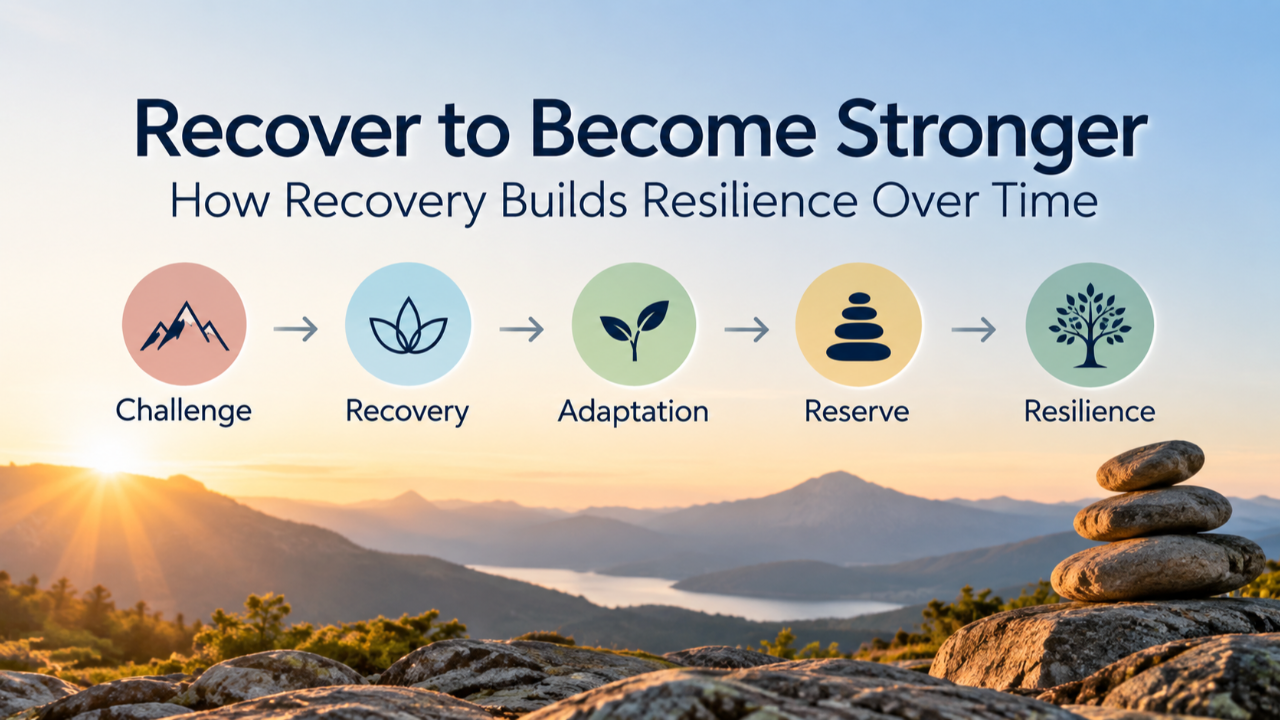
When we think about resilience, we often picture someone who can handle a lot.
Someone who keeps going despite a demanding schedule, a difficult season, an illness, a loss, or an unexpected setback. We may admire the person who seems able to push through almost anything and assume that resilience means being strong enough to withstand more.
But resilience isn't simply endurance.
True resilience includes something else: the ability to respond to a challenge, recover from it, adapt, and regain the capacity to meet whatever comes next.
That distinction matters.
Because if our definition of resilience is simply "keep going," we may completely overlook one of the processes that helps resilience develop in the first place:
Recovery.
Resilience Is Built Between the Challenges
Over the past several weeks, we've explored recovery from several different perspectives. We've looked at the work happening behind the scenes, the resources required to support that work, what happens when demands repeatedly exceed recovery, and some of the factors that help create better conditions for repair and adaptation.
Now let's pull those pieces together.
One way to think about the process is:
Challenge → Recovery → Adaptation → Reserve → Resilience
These aren't necessarily five neatly separated stages. Biology is far more complex than that. But this framework gives us a useful way to understand how today's choices and experiences can influence our capacity tomorrow.
Challenge
Life continually asks something of us.
A workout challenges muscles and metabolism. An infection activates the immune system. A stressful conversation triggers a neurological and hormonal response. Learning something new challenges the brain. A demanding workweek, travel, disrupted sleep, environmental exposures, illness, injury, caregiving, and emotional stress all require some degree of response.
Challenge itself isn't inherently bad. In fact, appropriate challenge is one of the ways we grow. But the challenge is only part of the story.
Recovery
After responding to a demand, the body needs an opportunity to restore what was used, repair what was disrupted, and reestablish balance.
That work requires energy, nutrients, time, appropriate signaling, and periods in which demands aren't continually piling on faster than the body can address them.
Recovery doesn't mean that nothing is happening. Quite the opposite.
It is an active period during which the body is doing the work necessary to prepare for what comes next.
Adaptation
When an appropriate challenge is followed by sufficient recovery, adaptation can occur.
This is easy to see with exercise. We don't become stronger simply because we lifted a weight. The exercise provided a stimulus. The changes that allow us to better tolerate that stimulus in the future occur afterward.
But the concept extends well beyond muscle.
Human physiology is remarkably adaptive. We continually adjust to physical, metabolic, emotional, cognitive, and environmental demands.
The important question isn't simply whether we experience stress. It's whether the overall pattern gives us an opportunity to adapt to it.
Reserve
Over time, repeated cycles of appropriate challenge, recovery, and adaptation can contribute to greater capacity.
This is where the idea of reserve becomes especially important.
Reserve gives us breathing room.
Think about two people encountering the same unexpected demand. Both may be capable of handling it, but one begins with more available capacity than the other. The demand may therefore represent a very different physiological burden for each person.
This is one reason health isn't simply about what happens to us. It is also about the condition of the system meeting the challenge.
Resilience
That brings us back to resilience.
Resilience doesn't mean becoming unaffected by stress, illness, loss, aging, or change. Nor does it mean developing a body capable of endlessly absorbing more demands.
It means having greater capacity to respond appropriately, recover, adapt when possible, and continue forward.
That is a much different definition of strength.
The Goal Isn't a Perfectly Controlled Life
Once we begin thinking about health this way, the goal changes.
It can be tempting to believe that if we eat perfectly, exercise correctly, manage stress, optimize our sleep, avoid toxins, take the right supplements, and make enough good choices, we can somehow create a life in which our bodies are never significantly challenged.
But that's not how life works.
We can't eliminate illness, aging, emotional stress, physical demands, environmental exposures, disrupted sleep, unexpected events, loss, or change.
And we probably wouldn't want to eliminate every challenge even if we could. Some challenges are precisely what stimulate growth.
Muscles need resistance to become stronger. Bones respond to mechanical loading. The brain changes when we learn difficult things. Confidence often develops because we've navigated something we once weren't sure we could handle.
The goal, then, isn't to build a life without challenge.
It's to build greater capacity to meet challenge and recover from it.
Health Becomes Less About Control and More About Capacity
This shift can change the way we think about wellness. Instead of constantly trying to control every variable, we can begin paying attention to capacity.
Do I have enough energy available for the demands I'm placing on my body?
Am I allowing periods of recovery between those demands?
Am I providing the raw materials my body needs?
Are my daily patterns supporting repair or continually asking for more?
Where might I be able to build greater reserve?
These questions are very different from asking, "What else should I be doing?"
That question can easily turn health into an endless checklist. More supplements. More exercise. More tracking. More optimization. More strategies. More things to remember.
Sometimes adding something is appropriate. But sometimes the more useful question is whether the body has enough resources and opportunity to respond to what we're already asking it to do.
This Is Where Terrain Thinking Becomes Powerful
Terrain thinking encourages us to look beyond a single symptom, behavior, or intervention and consider the larger internal environment in which health is unfolding.
Our metabolism, immune function, hormonal signaling, nervous system, sleep-wake rhythms, nutrient availability, movement, relationships, emotional state, and environment don't operate independently.
They continually influence one another. That means resilience isn't created by controlling one variable perfectly. It develops through the collective capacity of these interconnected systems to communicate, respond, repair, and adapt as conditions change.
And those conditions will change.
There will be weeks when sleep isn't ideal.
There will be periods of greater emotional stress.
There may be illness, injury, travel, caregiving responsibilities, work deadlines, hormonal changes, or circumstances we never anticipated.
The question isn't whether we can prevent every disruption.
The more useful question may be: "What kind of internal environment are we creating to meet it?"
Building for Tomorrow
One of the most powerful things about recovery is that its value isn't limited to how we feel today. Recovery can also be an investment in future capacity.
A nourishing meal doesn't guarantee that we'll never become ill. A good night's sleep doesn't erase every stressor. Strength training doesn't prevent every injury. Time spent regulating the nervous system doesn't mean we'll never feel overwhelmed.
Health doesn't work through guarantees. But repeated supportive choices can help create a stronger foundation from which the body responds to future demands.
That's the long game.
We aren't trying to create a body that never encounters difficulty. We're working toward a body with greater resources, adaptability, and reserve when difficulty inevitably arrives.
A Different Way to Think About Your Health
At the beginning of this journey, we asked an important question: How do I build greater reserve?
Over the past several weeks, we've added another piece: How do I support recovery?
Together, those questions give us a very different way to approach long-term health.
Instead of continually asking: "How do I eliminate stress?" or "What else should I be doing for my health?"
we can begin asking:
"What helps me recover?"
"What may be interfering with my recovery?"
"Where am I repeatedly asking for more than I'm restoring?"
"What resources can I build today that may help me respond better tomorrow?"
These aren't questions we answer once. They change as we change.
What supported us in our 30s may not be what we need in our 50s or 70s. What works during a relatively calm season may not be enough during illness, caregiving, grief, or significant life change.
Resilience requires flexibility.
And perhaps that's one of the most important lessons of all. Health isn't about achieving a perfectly optimized state and somehow staying there. It's about developing the capacity to respond to a changing life.
Recover to Thrive
These ideas have become the foundation for something I've been working on behind the scenes-an online course called Recover to Thrive: A Metabolic Approach to Building Health and Resilience.
The course grew out of a simple idea: health isn't only about reducing stress, making healthier choices, or finding the next thing we can do to the body. It's also about understanding what the body needs to respond, recover, adapt, and build greater capacity over time.
In Recover to Thrive, we'll take a deeper dive into many of the concepts we've been discussing throughout this series including stress and adaptive reserve, mitochondrial energy, circadian biology, nutrition, nervous-system regulation, movement and tissue repair, connection, and the many ways these factors work together to influence recovery and resilience.
I'm almost finished creating the course, so I'll be sharing more in the coming weeks. But whether or not you ever take the course, I hope this series leaves you with a different way of thinking about your health.
Rather than measuring strength only by how much you can endure, consider asking: "How well can I respond, recover, adapt, and rebuild?"
And instead of always looking for the next thing to add, optimize, or control, perhaps sometimes the better question is: "What does my body need in order to recover from what I'm already asking of it?"
Because the goal isn't to create a perfectly controlled life or a body that never encounters difficulty.
It's to build greater capacity for the life you're actually living.
That's what it means to Recover to Thrive.
Because long-term health isn't built only through what challenges us.
It's also built through how well we recover.
If you are interested in more information, schedule a free Discovery Call.
Let's stay connected!
Join my free Terrain Wellness Community
or sign up for my mailing list to receive the latest news and updates.
I will never sell your information, for any reason.
