Not All Stress Is Bad: Understanding the Difference Between Helpful and Harmful Stress
foundations of healing lifetsyle & daily support metabolic health & cancer Jul 28, 2026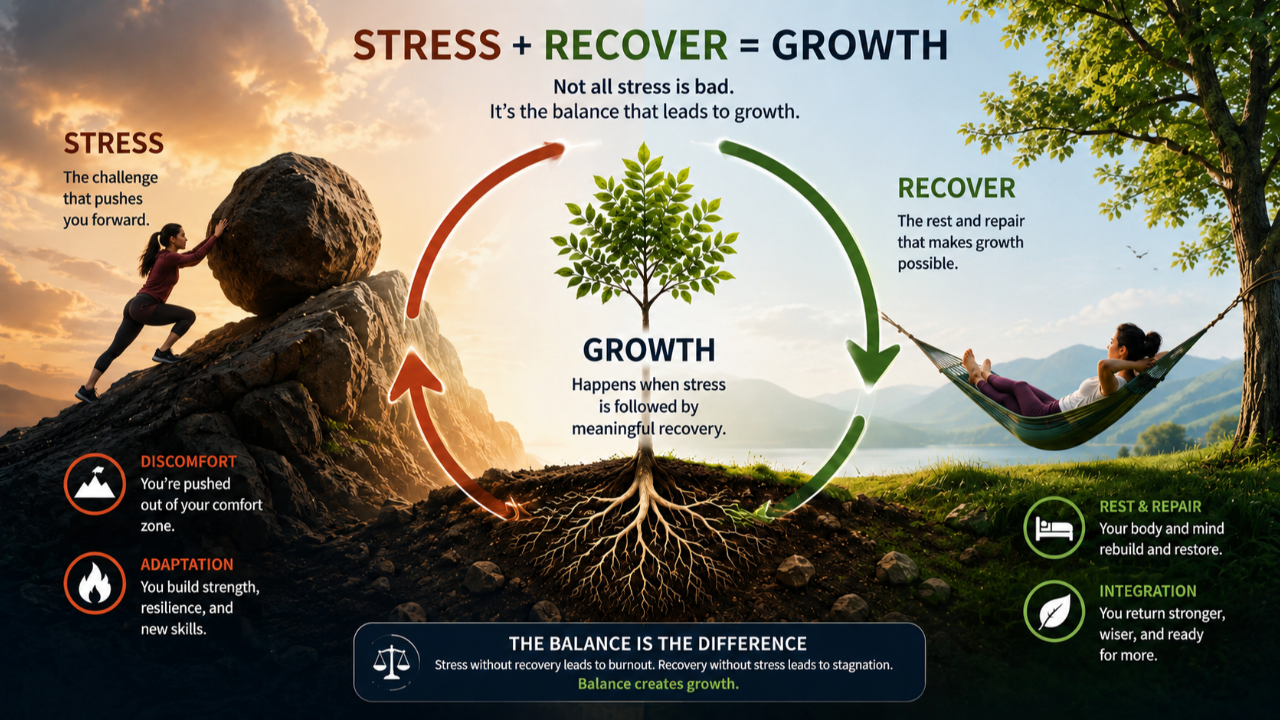
When you hear the word stress, what comes to mind?
Most people think of long workdays, emotional overwhelm, financial worries, illness, or lack of sleep. We often hear that stress is harmful and chronic stress certainly can be.
But stress itself isn't the enemy. In fact, your body was designed to experience stress. Without it, you wouldn't become stronger, healthier, or more resilient.
The real question isn't whether stress exists. It's whether your body has the ability to adapt and recover from it.
Understanding that difference can completely change the way you think about health.
Your Body Was Built to Adapt
One of the most remarkable features of the human body is its ability to adapt. Every day your body responds to thousands of changing conditions:
- temperature
- physical activity
- food availability
- infections
- emotional experiences
- mental challenges
- environmental exposures
Rather than trying to eliminate every challenge, your body is constantly learning from them. Scientists call this process adaptation.
When the challenge is appropriate and recovery follows, your body becomes more capable of handling future stress. This process is known as hormesis.
Hormesis describes how small, manageable doses of stress stimulate beneficial adaptations that make the body stronger and more resilient over time.
Think of it like strengthening a muscle. A weight that is challenging but not overwhelming causes tiny amounts of stress within the muscle. During recovery, the muscle repairs itself and becomes stronger than before.
Many of the healthiest activities we choose actually work because they create this type of beneficial stress.
Healthy Stress Comes in Many Forms
When most people think of stress, they think only of emotional stress. But your body recognizes many different types of temporary challenges.
Examples include:
- Strength training
- Walking uphill
- Interval exercise
- Heat exposure such as a sauna
- Cold exposure
- Intermittent fasting or extending the time between meals
- Learning a new language or musical instrument
- Solving difficult problems
- Building emotional resilience through healthy relationships and personal growth
None of these experiences are comfortable all the time. That discomfort is part of what stimulates adaptation.
The goal isn't suffering. The goal is challenging the body just enough that it becomes more capable.
Acute Stress vs. Chronic Stress
Not all stress affects the body the same way. The duration of the stress, its intensity, and whether recovery occurs all influence how the body responds.
Acute stress
Acute stress is short-lived. Your body rises to meet the challenge and then returns to balance.
Examples include:
- exercising
- giving a presentation
- taking a cold shower
- recovering from a workout
- climbing a steep hill
- completing a mentally demanding task
Acute stress activates protective systems that help you perform, adapt, and recover. Once the challenge ends, the body returns to a more balanced state.
When the challenge is appropriate and adequate recovery follows, this type of stress can make us stronger.
Chronic stress
Chronic stress is different. Instead of short periods of activation followed by recovery, the body remains in a prolonged state of demand.
Examples might include:
- ongoing financial worries
- chronic inflammation
- persistent infections
- poor sleep over months or years
- unresolved emotional stress
- excessive work demands without adequate rest
- continual blood sugar instability
- nutrient deficiencies
- environmental toxin exposure
Rather than building resilience, chronic stress gradually depletes it. The body must devote more and more energy simply to keeping up, leaving fewer resources available for repair, restoration, and adaptation.
Your Adaptive Reserve: Your Body's Hidden Reserve Tank
Imagine your body has an internal reserve tank. Scientists often refer to this concept as adaptive reserve. It represents your capacity to respond to life's challenges without becoming overwhelmed.
Adaptive reserve represents your capacity to respond to life’s challenges without becoming overwhelmed. When your reserve is strong, you may recover more quickly, tolerate exercise more easily, navigate emotional setbacks more effectively, and handle everyday stressors without feeling depleted.
When your reserve becomes diminished, even relatively small challenges can feel overwhelming. A poor night’s sleep, a minor illness, skipping a meal, a busy week, or a difficult conversation may not seem significant on its own. However, when your reserve is already running low, that additional demand can feel much larger than it normally would.
This is one reason two people can experience the exact same situation and respond very differently. The difference often lies less in the stress itself and more in the body's capacity to adapt.
Metabolic Flexibility: The Foundation of Resilience
A healthy terrain depends on metabolic flexibility. Metabolic flexibility is your body's ability to efficiently adjust to changing energy demands.
For example, a metabolically flexible body can:
- switch between burning carbohydrates and fat when appropriate
- tolerate longer periods between meals
- recover efficiently after exercise
- respond appropriately to changing activity levels
- maintain more stable energy throughout the day
When metabolic flexibility decreases, even ordinary daily demands require more effort. The body becomes less adaptable, less efficient, less resilient.
This doesn't happen overnight. It develops gradually through the cumulative effects of lifestyle, nutrition, sleep quality, physical activity, environmental exposures, and aging.
Why Resilience Often Declines with Age
Many people notice they don't recover as quickly as they once did. A poor night's sleep that was insignificant at age thirty may require several days of recovery at age sixty.
This isn't simply because of getting older. Part of the change reflects a gradual decline in adaptive reserve.
As we age, our bodies often experience:
- reduced mitochondrial efficiency
- slower tissue repair
- changes in hormone communication
- decreased muscle mass if strength training is neglected
- reduced metabolic flexibility
- greater cumulative exposure to inflammation and oxidative stress
The encouraging news is that many of these changes are influenced by lifestyle. Regular movement, resistance training, nourishing foods, restorative sleep, meaningful social connections, stress management, and recovery practices all help support the body's ability to adapt, even later in life.
Healthy aging is not about avoiding every challenge. It's about maintaining the capacity to respond to life's inevitable challenges.
Why Healthy Terrain Changes Everything
This is where the concept of terrain becomes especially important.
When the terrain of your body is healthy:
- inflammation is better regulated
- energy production is more efficient
- hormones communicate more effectively
- immune responses are more balanced
- recovery systems work more efficiently
All of these systems contribute to resilience.
On the other hand, when terrain has been compromised over time by poor nutrition, chronic inflammation, persistent stress, inadequate recovery, or other ongoing burdens, the body has fewer resources available to adapt.
As a result, everyday challenges begin to feel larger than they once did. It's not because you're weak. It's because your body is working harder just to maintain balance.
The goal isn't to eliminate every source of stress. It's to improve the terrain so your body can respond to stress more effectively.
Recovery Is Where Resilience Is Built
Exercise doesn't make you stronger. Recovery after exercise does.
Learning doesn't reshape the brain during the lesson. Much of the adaptation and integration occurs afterward.
The same principle applies throughout the body. Recovery is when tissues repair, when energy stores are replenished, when proteins are rebuilt, when the nervous system recalibrates, and when the body integrates the lessons from the challenge it just experienced.
Without recovery, stress simply accumulates. With recovery, stress becomes an opportunity for growth.
Final Thoughts
Modern culture often teaches us to avoid stress whenever possible, but biology tells a different story.
Healthy bodies don't become resilient by avoiding every challenge. They become resilient by experiencing appropriate challenges, adapting to them, and recovering well afterward.
Rather than asking, "How can I eliminate every source of stress?" consider asking:
"How can I better support my body's ability to recover?"
Because resilience isn't built during the challenge. It's built in what comes next.
If you are interested in more information, schedule a free Discovery Call.
Let's stay connected!
Join my free Terrain Wellness Community
or sign up for my mailing list to receive the latest news and updates.
I will never sell your information, for any reason.
