
Invisible Stressors: The Ones You Don't Think Are Affecting Your Health
Aug 11, 2026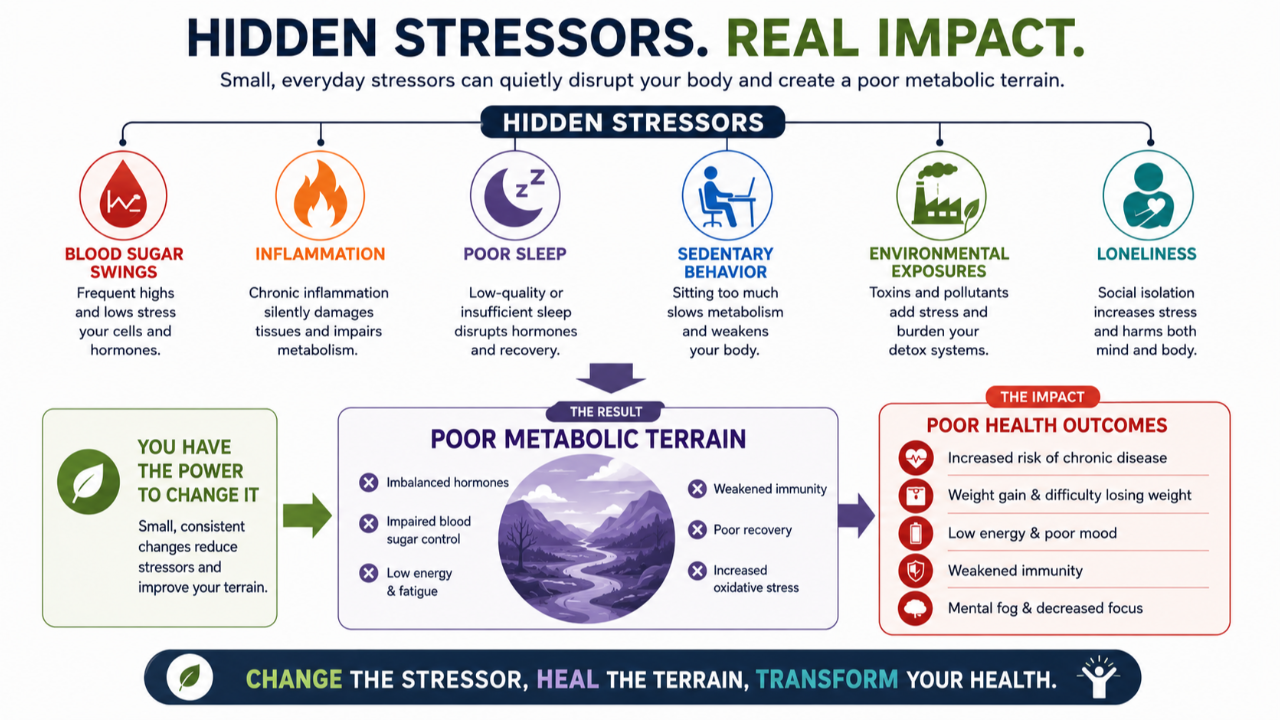
When we hear the word stress, most of us think about the things we can feel: a difficult relationship, a demanding job, financial uncertainty, caregiving responsibilities, conflict, grief, or simply having too much to do. These experiences absolutely matter. But emotional stress is only one form of stress the body has to navigate.
Your body is constantly responding to information from both inside and outside of you. The food you eat, the stability of your blood sugar, the quality of your sleep, how much you move, the light your eyes receive, the substances you're exposed to, the inflammatory signals circulating through your body, and even the quality of your relationships all become part of the biological environment your cells must respond to.
Some of those signals support adaptation and resilience. Others require the body to work harder to maintain balance.
And here's the part we often miss: you don't necessarily have to feel stressed for your body to be experiencing stress.
Understanding this broader definition of stress can change the way we think about health and about the terrain of the body.
Stress Is Bigger Than a Feeling
In last week's blog, we explored how the brain is constantly making predictions about what is happening around us. Rather than simply reacting to the world, the brain uses past experiences, current sensory information, and signals from within the body to anticipate what might happen next.
But what exactly is it receiving information about? Far more than we consciously notice.
Your nervous system and cells are continuously detecting changes in energy availability, temperature, light, movement, nutrients, hormones, inflammatory molecules, environmental exposures, social connection, and countless other signals. Much of this monitoring happens quietly in the background.
This means stress can be physiological without necessarily being psychological.
A blood sugar spike doesn't have to make you feel anxious to require a metabolic response. Sitting for eight hours may not feel particularly stressful, but prolonged inactivity changes the signals being sent throughout the body. Poor sleep may become so familiar that you barely think about it, even while your metabolism, immune system, hormones, and brain are compensating for inadequate recovery.
The body doesn't categorize stress the way we do. It simply responds to the information it receives.
Metabolic Stress: When Maintaining Balance Requires More Work
Your metabolism is constantly adjusting to keep the internal environment relatively stable. Blood glucose must be regulated. Energy must be produced. Damaged molecules must be repaired or removed. Hormones need to communicate. Immune activity needs to be appropriately activated and resolved.
When these systems are repeatedly challenged, the body may have to devote more resources toward maintaining balance.
Consider blood sugar. After eating carbohydrates, blood glucose naturally rises and insulin helps move glucose into cells. That is normal physiology. But frequent large fluctuations in glucose and insulin can create a very different metabolic environment than relatively stable energy availability.
Repeated spikes and crashes can influence hunger, energy, inflammation, oxidative stress, and hormonal signaling. You may experience those fluctuations as fatigue, cravings, irritability, or brain fog or you may barely notice them at all. Either way, your cells are responding.
This is one reason metabolic health isn't simply about weight or whether someone has diabetes. It is also about how efficiently the body regulates energy and adapts to the metabolic demands placed upon it.
Inflammation Is Also Information
Inflammation is often portrayed as something inherently harmful, but inflammation itself is an essential biological response. Your immune system uses inflammatory signaling to respond to infection, injury, damaged tissue, and other threats.
The problem is not that inflammation exists. The problem can arise when inflammatory signals remain elevated or are repeatedly triggered without adequate resolution.
Chronic low-grade inflammation can influence communication throughout the body, including communication between the immune system, metabolism, hormones, and brain. Inflammatory signals can even affect how the brain interprets information coming from the body and the surrounding environment.
This creates an important connection with our discussion from last week: the condition of the terrain can influence the information the brain receives, while the brain's interpretation of the environment can influence the terrain.
The relationship goes both directions.
Your Environment Is Communicating With Your Biology
Some of the most overlooked stressors aren't happening inside the body at all. They are coming from the environment around us.
Air pollution, certain chemicals, excessive noise, artificial light at night, and other environmental exposures can create biological demands even when we aren't consciously aware of them.
Take noise pollution. You might eventually become accustomed to traffic, airplanes, construction, or other background noise. After a while, you may barely notice it. Your nervous system may not be quite as indifferent.
Persistent environmental noise has been associated with activation of stress pathways and disturbances in sleep and cardiovascular physiology. The important concept isn't that every sound is dangerous. It's that the body continually evaluates its surroundings, even when our conscious attention has moved elsewhere.
Environmental exposures can work in similar ways. The body has systems designed to process and eliminate many of the compounds we encounter every day. The goal isn't to fear every chemical or create an impossible "toxin-free" life. Instead, it is useful to recognize that the body's ability to process environmental exposures is part of the total workload placed upon the terrain.
Exposure matters, but so does capacity.
Food Is More Than Fuel
We often think about food primarily in terms of calories, carbohydrates, protein, and fat. But food is also information.
The nutrients and compounds within food interact with metabolic pathways, hormones, immune cells, the gut microbiome, and cellular signaling systems.
A diet dominated by ultra-processed foods can provide a very different set of biological signals than one centered around minimally processed whole foods. Highly refined foods may promote rapid glucose changes while providing fewer of the micronutrients, fiber, and phytochemicals that support normal cellular function.
This doesn't mean that one processed meal damages your terrain or that health requires perfect eating. The more useful question is:
What signals are my cells receiving most often?
One meal is a signal.
Your overall pattern becomes the environment.
Sitting Still Sends a Signal Too
Movement is another form of biological information.
Muscle isn't simply tissue that helps us exercise. Contracting muscles release signaling molecules and influence glucose metabolism, circulation, mitochondrial function, insulin sensitivity, and inflammatory regulation.
That means movement communicates with the rest of the body. And the absence of movement communicates something as well.
A person can exercise for 30 minutes in the morning and still spend most of the remaining day sedentary. These aren't necessarily equivalent signals. Structured exercise is valuable, but so are the smaller movements woven throughout the day: walking, standing, climbing stairs, gardening, carrying groceries, stretching, or simply getting up from a chair regularly.
You don't have to turn every movement into a workout. Sometimes the body simply needs reminders that it was designed to move.
Light Is Biological Information
Light may be one of the most powerful environmental signals we routinely underestimate.
Your eyes don't just use light to help you see. Specialized cells in the retina communicate information about light and darkness to areas of the brain that help regulate your circadian rhythm.
Morning daylight helps tell the brain that the biological day has begun. Darkness in the evening helps support the signals associated with nighttime physiology. Modern life can scramble those messages.
We may spend much of the daytime indoors under relatively dim artificial lighting and then expose ourselves to bright lights and screens late into the evening. From the body's perspective, the distinction between day and night becomes less obvious.
Again, you may not consciously experience this as stress. But circadian disruption can influence sleep, metabolism, hormone signaling, immune regulation, and recovery.
Sometimes supporting the terrain isn't about adding something complicated. It may simply mean giving the body clearer information about what time it is.
Loneliness Is Not "Just Emotional"
There is another invisible stressor that deserves particular attention: lack of meaningful human connection.
Humans are social organisms. Our nervous systems developed in environments where belonging to a group contributed to survival. Connection, touch, conversation, shared experiences, and supportive relationships can provide powerful signals of safety.
Loneliness is therefore more than an unpleasant emotion.
Persistent social isolation or perceived loneliness can interact with stress physiology, sleep, inflammation, immune function, and cardiovascular health. This doesn't mean that everyone needs a large social circle. For many people, a few dependable, meaningful relationships may matter far more than constant social activity.
The quality of connection matters.
A relationship in which you can relax, feel respected, and be yourself sends very different signals than one that requires constant vigilance, uncertainty, or self-protection.
Our relationships become part of our biological environment too.
Poor Recovery May Be the Stressor We Overlook Most
We've talked before about the difference between helpful and harmful stress. Challenge itself isn't necessarily the problem. In fact, appropriate stress followed by adequate recovery can make the body stronger.
Exercise is an excellent example. Exercise temporarily challenges muscles, energy systems, and cardiovascular function. Recovery allows adaptation to occur.
The same principle applies more broadly. Your body is remarkably capable of handling metabolic demands, emotional challenges, physical activity, environmental exposures, and occasional disrupted sleep. But adaptation requires opportunities to recover.
When stressors continue to accumulate while sleep, nutrition, movement, downtime, and social connection remain inadequate, the body may spend more time compensating and less time restoring. That is why recovery isn't a luxury. It is part of the biological process that allows us to remain resilient.
The "Total Load" Matters
One of the most useful ways to think about invisible stressors is not to obsess over any single exposure but to consider the cumulative load.
Imagine two people experiencing the same demanding week. One is sleeping well, eating nourishing meals, moving regularly, spending time outside, feeling connected to supportive people, and entering the week with relatively low inflammatory and metabolic burden.
The other is sleeping poorly, experiencing large blood sugar fluctuations, sitting most of the day, dealing with ongoing inflammation, rarely seeing daylight, and feeling socially isolated.
The external stressor may be identical. The biological context isn't.
This is where the concept of terrain becomes especially useful. Resilience isn't determined only by what happens to us. It is also influenced by the condition of the system receiving the challenge.
A healthier terrain doesn't mean that stress disappears. It means the body may have greater capacity to respond, adapt, recover, and return toward balance.
Everything Communicates With the Body
It can be tempting to read a list of invisible stressors and immediately start trying to eliminate all of them. That's not the goal.
Life will always contain stress. We will eat imperfect meals, have sleepless nights, spend long days sitting, encounter environmental exposures, experience conflict, and go through periods when recovery isn't ideal.
Health doesn't require eliminating every stressor. Instead, begin noticing the signals that dominate your everyday life.
Ask yourself:
- Am I giving my body clear signals of daytime and nighttime?
- Do I move throughout the day, not just during workouts?
- Are most of my meals providing nutrients rather than simply calories?
- Does my daily pattern generally support stable energy?
- Do I have opportunities for genuine rest and recovery?
- Are there environmental exposures I can reasonably reduce?
- Do my closest relationships provide connection and a sense of safety?
- Am I continually asking my body to adapt without giving it time to recover?
You don't need to fix everything at once. In fact, trying to optimize every aspect of your life can become another source of stress.
Choose one signal you can improve.
Get outside for morning light. Take a ten-minute walk after dinner. Add a whole food to your meal. Stand up during the workday. Turn down the lights earlier in the evening. Call someone who helps you feel connected. Protect an hour of genuine downtime.
Small choices can seem insignificant when viewed individually. Biologically, however, they are messages. And messages repeated over time become patterns.
Building a Healthier Terrain One Signal at a Time
Your body is listening all day long, not in a fearful or fragile way, but because responsiveness is one of the things that keeps you alive.
Your metabolism adjusts.
Your immune system monitors.
Your nervous system interprets.
Your circadian system tracks light and darkness.
Your cells respond to nutrients, movement, hormones, inflammatory signals, and the environment around them. This is why supporting health is rarely about finding one perfect food, supplement, exercise program, or morning routine.
Healthy terrain isn't built from one perfect decision. It's shaped by thousands of small signals over time.
The goal isn't perfection. It is to gradually shift the balance toward signals that support regulation, recovery, and resilience. Because everything communicates with the body. And when we begin to understand that language, everyday choices stop looking insignificant. They become opportunities to support the terrain in which health is built.
If you are interested in more information, schedule a free Discovery Call.
Let's stay connected!
Join my free Terrain Wellness Community
or sign up for my mailing list to receive the latest news and updates.
I will never sell your information, for any reason.
