
Hormones Are Messengers: Why Healthy Communication Matters More Than Perfect Levels
Jun 30, 2026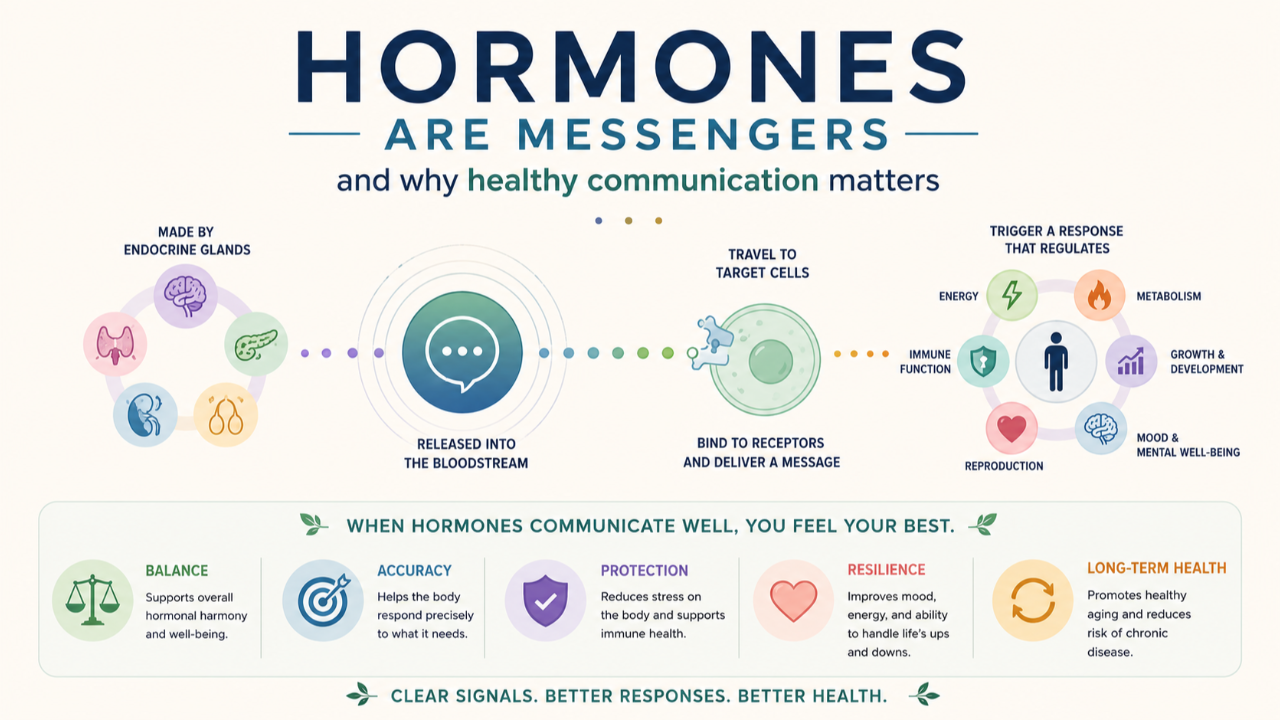
When many people think about hormones, they imagine numbers on a lab report.
High estrogen.
Low progesterone.
Elevated cortisol.
Low thyroid.
It's easy to believe that if we could simply "balance" those numbers, everything would improve.
But hormones are far more sophisticated than that.
Rather than acting independently, hormones function as an incredibly complex communication system that coordinates nearly every process in the body from energy production and metabolism to sleep, appetite, mood, reproduction, immune function, and healing.
From a metabolic perspective, healthy hormones aren't simply about producing enough hormones.
They're about healthy communication.
Hormones: Your Body's Communication Network
Imagine sending an important email.
Writing the email is only the first step.
For communication to happen successfully:
- The message must reach the correct recipient.
- The recipient has to open it.
- They must understand the information.
- Then they need to respond appropriately.
If any one of those steps breaks down, communication suffers even if the email itself was written perfectly.
Hormones work much the same way.
A hormone is simply the messenger.
Once produced, it travels through the bloodstream looking for cells that contain the appropriate receptor-specialized proteins that act like a mailbox, lock, or docking station.
When the hormone reaches the right receptor, it delivers instructions that influence how the cell behaves.
Only then can the message become action.
This means that producing hormones is only one part of the equation.
The message still has to be received.
Every Hormone Has a Job
Your body doesn't produce hormones randomly.
Each hormone carries very specific instructions.
Some help regulate blood sugar. Others influence metabolism, energy production, fertility, growth, digestion, sleep, appetite, inflammation, or stress adaptation.
Some of the body's most well-known hormones include:
- Insulin, which helps move glucose into cells for energy.
- Cortisol, which helps you respond to physical and emotional stress.
- Thyroid hormones, which regulate metabolism and cellular energy production.
- Estrogen and progesterone, which influence reproductive health but also affect bone health, cardiovascular function, brain health, and immune activity.
- Leptin, which communicates fullness and long-term energy availability.
- Ghrelin, which signals hunger.
Although we often discuss these hormones individually, they never function in isolation. They're constantly responding to one another.
Think of it less like a collection of solo performers and more like an orchestra. Each instrument plays a different part, but the beauty of the music depends on how well they work together.
Communication Is More Important Than Quantity
One of the most surprising concepts in hormone health is this:
Having "normal" hormone levels doesn't always mean communication is working optimally.
Sometimes the body produces an appropriate amount of a hormone, but the receiving cells don't respond efficiently.
This idea is known as hormone sensitivity, or how responsive cells are to hormonal signals.
Imagine knocking on someone's front door. If no one answers, the message isn't received even though you arrived exactly where you were supposed to.
Similarly, cells can become less responsive to hormonal messages for many reasons.
Researchers often describe this phenomenon with hormones such as insulin, where cells become less responsive over time. While insulin resistance is the most familiar example, the broader principle applies across many hormone systems: effective communication depends not only on producing the messenger, but also on the cell's ability to receive and respond.
This is why supporting overall cellular health is such an important part of a metabolic approach to wellness.
Hormones Are Always Adapting
One of the body's greatest strengths is its ability to adapt.
Hormones are continually adjusting based on what your body perceives is happening around you.
Consider what happens after several nights of poor sleep.
Your stress hormones may rise.
Hunger hormones may change, increasing cravings for quick energy.
Blood sugar regulation may become less efficient.
Energy production often declines.
None of these changes necessarily mean your body is "broken."
They're adaptive responses to the information your body is receiving.
The same is true during:
- Chronic emotional stress
- Undernourishment
- Blood sugar instability
- Illness
- Infection
- Excessive exercise
- Long-term sleep deprivation
Your hormones are constantly responding to both your internal and external environment.
Rather than asking, "What's wrong with my hormones?"
A more helpful question might be:
"What is my body responding to?"
That simple shift encourages curiosity instead of frustration.
The Terrain Shapes the Conversation
This is where the metabolic terrain perspective becomes especially valuable.
Hormones don't exist independently from the rest of your health.
The environment inside your body, your terrain, influences how well hormonal communication occurs.
Factors such as:
- Blood sugar regulation
- Nutrient availability
- Sleep quality
- Chronic stress
- Inflammation
- Mitochondrial function
- Physical activity
- Digestive health
all influence how effectively hormone messages are sent, received, and acted upon.
Instead of trying to force hormones into balance, we can begin supporting the conditions that allow healthy communication to occur naturally.
It's a subtle but important shift.
Rather than controlling hormones, we're supporting the environment in which they function.
A Different Way to View Symptoms
Many of the symptoms people associate with "hormone problems": fatigue, sleep changes, mood shifts, brain fog, weight changes, irregular cycles, or fluctuating energy, can understandably feel frustrating.
But symptoms are not always signs that your body is failing.
Often, they're information.
They're clues that your body is adapting to the conditions it's experiencing.
When we become curious about those signals instead of immediately trying to silence them, we often gain a deeper understanding of what our body truly needs.
That curiosity becomes the foundation for making thoughtful, sustainable changes rather than chasing quick fixes.
Bringing It All Together
The body is remarkably intelligent!
Every day, billions of hormone messages are sent between organs, tissues, and cells, helping your body adapt to changing circumstances.
Healthy hormone function isn't simply about producing more or less of any one hormone.
It's about creating an internal environment where communication can occur clearly and efficiently.
As we explore hormones throughout this month, we'll continue looking beyond individual hormone levels to understand the many factors that influence this intricate communication network.
Because when the terrain supports healthy communication, the body is often better equipped to do what it was designed to do.
Healthy hormones begin with healthy communication, not control.
Instead of asking whether your hormones are "balanced," consider asking:
How well is my body communicating?
That small shift in perspective can change the way you think about your health—and the choices you make to support it.
If you are interested in more information, schedule a free Discovery Call.
Let's stay connected!
Join my free Terrain Wellness Community
or sign up for my mailing list to receive the latest news and updates.
I will never sell your information, for any reason.
