Recovery Is More Than Rest: What Your Body Is Actually Doing Behind the Scenes
Sep 01, 2026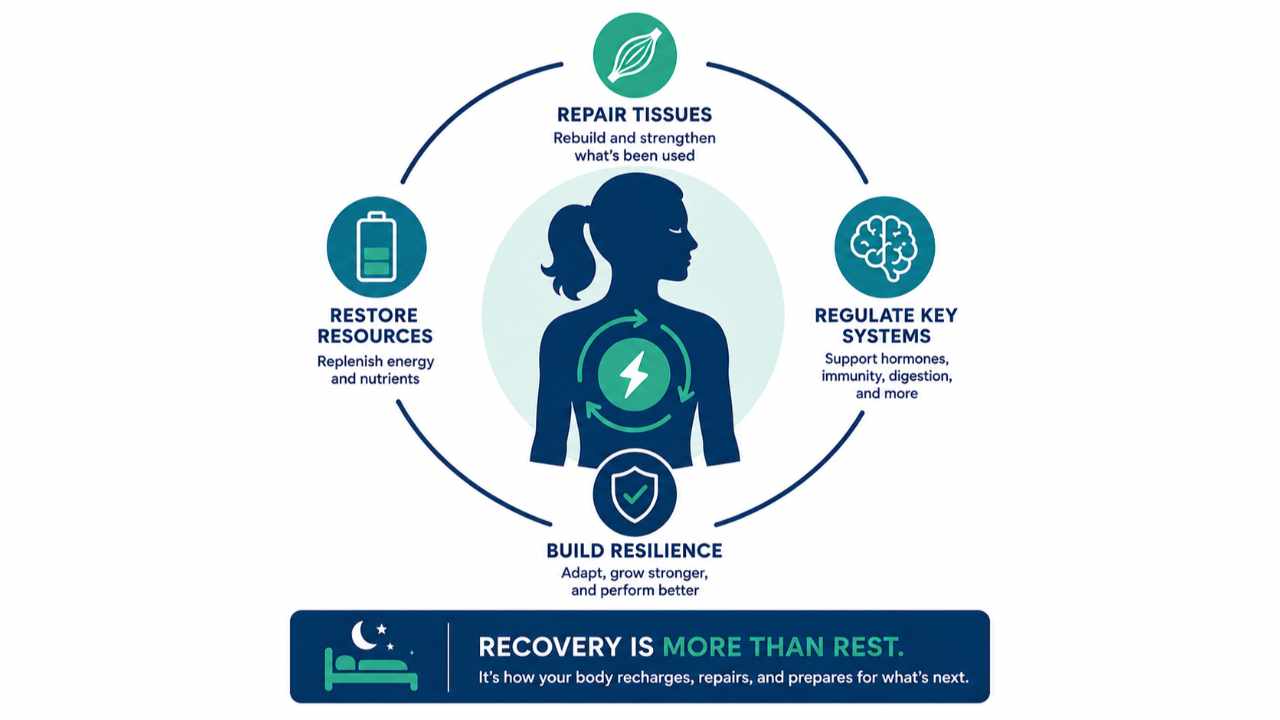
When you hear the word recovery, what comes to mind?
Maybe it's getting a good night's sleep after a long week, putting your feet up after a busy day, taking a rest day from exercise, or finally getting some downtime after a stressful period of time.
All of those things can be valuable. They create space for recovery. But they aren't quite the same thing as recovery itself.
There is an important distinction:
Rest is something we do.
Recovery is something the body does.
While we may think of recovery as a period when "nothing is happening," the opposite is true. Behind the scenes, the body is remarkably active. Cells are repairing damage, tissues are being rebuilt, energy resources are being restored, immune activity is being regulated, and countless signals are being coordinated to prepare us for what comes next.
Recovery isn't simply downtime.
It is biological work.
Your Body Doesn't Just Stop. It Changes Priorities.
Think about what happens during a demanding period.
Maybe you are exercising, concentrating on a difficult task, fighting an infection, navigating an emotionally stressful situation, or simply moving through a packed day. Your body continually adjusts its priorities to meet the demands of the moment. Energy and resources are directed toward what is needed right now.
Then the demand changes. The workout ends. The presentation is over. The stressful conversation passes. You finish the day's responsibilities and eventually go to sleep.
Your body's work isn't finished just because the obvious challenge has ended. Now it has a different job to do. Resources can be redirected toward maintenance, repair, rebuilding, and restoration.
This is one reason recovery is much more than simply "taking it easy." Recovery represents a shift in biological priorities from meeting the immediate demand toward restoring the systems that helped you meet it.
What Is Your Body Actually Doing During Recovery?
There isn't one single recovery system or recovery switch. Recovery involves multiple processes occurring throughout the body, often simultaneously.
Repairing and Rebuilding Tissues
Everyday life creates wear and tear. Exercise stresses muscle fibers. Normal metabolism produces molecules that can damage cellular structures. Tissues are continually being broken down and rebuilt.
The body responds through ongoing repair. Damaged proteins may be removed or repaired. New proteins are produced. Cell membranes are maintained. Connective tissues remodel. Muscles respond to the demands placed upon them.
This becomes particularly obvious after exercise. A strength workout provides the stimulus, but the workout itself isn't when all of the rebuilding occurs. The challenge sends a message that the body needs to adapt. The hours and days that follow provide the opportunity for repair and remodeling.
That means the benefit doesn't come from the challenge alone.
The challenge provides the signal. Recovery helps build the response.
Restoring Energy Resources
Recovery also requires replenishing the resources used during activity.
Muscles and the liver store glucose in the form of glycogen, which can be drawn upon when energy demands increase. Those stores need to be replenished. Fluid and electrolytes lost through normal activity, exercise, heat, or illness need to be restored as well.
At the cellular level, mitochondria continue the enormous task of producing the energy necessary to support these processes.
This leads to an important point that often gets overlooked: Recovery requires energy.
Repairing tissues requires energy. Producing new proteins requires energy. Maintaining cells requires energy. Regulating immune activity requires energy. Restoring balance requires energy.
The body isn't "doing nothing" during recovery. It is spending resources on an enormous amount of behind-the-scenes work.
The Immune System Has Recovery Work to Do, Too
We often think about the immune system primarily when we're sick, but immune activity is involved in much more than fighting infections.
Immune cells also participate in cleanup and repair. They help respond to damaged tissue, coordinate inflammatory processes, and contribute to the transition from tissue disruption toward healing.
Inflammation itself isn't automatically a problem. A temporary inflammatory response can be an important part of repair.
The goal isn't necessarily to eliminate every inflammatory signal. The body needs to be able to initiate an appropriate response and then regulate it as the job gets done.
This is another example of why recovery depends upon coordination. Starting a response is only part of the process. The body also needs to know when and how to shift toward repair and resolution.
Your Brain and Nervous System Need Recovery, Too
Physical activity isn't the only thing that creates demand.
Your brain consumes considerable energy and continuously processes information about both your internal and external environment. Learning, concentrating, making decisions, solving problems, navigating uncertainty, and managing emotional experiences all require resources.
Recovery from these demands doesn't necessarily mean shutting your brain off. During periods of rest and sleep, the brain continues processing information, consolidating learning and memory, and reorganizing what it has experienced. A mentally demanding day may therefore require recovery even if you barely moved from your chair.
The same is true of emotional stress.
After an emotionally charged experience, your nervous system doesn't necessarily return to baseline the instant the situation ends. Heart rate, breathing, muscle tension, attention, and stress-related signaling may need time to shift. Recovery includes helping those systems transition away from a state of heightened demand.
This is one reason activities such as walking, spending time outdoors, connecting with people you enjoy, engaging in something pleasurable, or simply having periods without constant stimulation can feel restorative. They may help create conditions that allow the nervous system to change gears.
Even Ordinary Life Creates a Recovery Need
We don't need an intense workout, illness, or major stressful event to require recovery. Normal life creates continuous metabolic work.
We digest food, regulate body temperature, maintain blood sugar, replace cells, produce hormones and neurotransmitters, move nutrients into cells, remove cellular byproducts, maintain fluid balance, respond to environmental signals, think, move, work, and interact with the people around us.
Much of this happens without our awareness. That means recovery isn't something reserved for athletes, people recovering from illness, or someone who has reached exhaustion.
Recovery is part of normal physiology.
The body is continually balancing what needs to be accomplished now with what needs to be repaired, restored, or replenished for later.
Rest Creates Opportunity, but It Doesn't Guarantee Recovery
This is where the difference between rest and recovery becomes especially important.
Imagine two people spending the evening sitting on the couch. Technically, both are resting. But one ate nourishing meals throughout the day, stayed adequately hydrated, had some movement and daylight exposure, feels relatively calm, and will get a solid night's sleep.
The other slept poorly the night before, skipped meals, has been running on caffeine, spent the day under significant emotional strain, and is scrolling through stimulating content until midnight.
Their activity level at that moment may look similar, but the biological conditions supporting recovery are very different.
Simply stopping activity doesn't automatically provide the body with everything it needs to recover effectively. Recovery depends upon resources, timing, and the signals the body is receiving.
Those signals can come from many places, including:
-
adequate nutrition and hydration
-
sleep and circadian rhythms
-
appropriate movement
-
periods of reduced demand
-
nervous-system regulation
-
social connection
-
metabolic health
-
the availability of energy and nutrients needed for repair
This is why someone can spend plenty of time "resting" and still not feel particularly restored.
The question isn't only: Did I stop doing things?
A better question may be: Did I create the conditions my body needs to do its recovery work?
Different Challenges Require Different Types of Recovery
Another reason recovery can't be reduced to "get more rest" is that different demands create different recovery needs.
After exercise, muscles need resources for repair, glycogen replenishment, tissue remodeling, and adaptation.
After illness, the immune system may have expended substantial energy coordinating defense and repair while the body works to restore normal function.
After a mental challenge, the brain needs opportunities to process information, consolidate learning, and replenish the resources required for continued concentration.
After emotional stress, the nervous system may need time and appropriate signals to transition away from heightened vigilance.
And after the accumulated metabolic demands of everyday life, cells still require opportunities for maintenance, cleanup, energy restoration, and repair.
This helps explain why there isn't one perfect recovery strategy.
Sometimes recovery means sleep.
Sometimes it means eating.
Sometimes it means gentle movement after sitting all day.
Sometimes it means stepping away from constant stimulation.
Sometimes it means connecting with someone rather than isolating.
And sometimes it really does mean putting your feet up and doing absolutely nothing for a while.
The goal isn't to perform recovery perfectly. It's to recognize that the body has different needs depending upon the demands it has been asked to meet.
Recovery Is an Active Part of Building Health
Our culture tends to celebrate the visible part of progress:
The workout.
The long workday.
The accomplishment.
The discipline.
The challenge.
Recovery is quieter, so it is easy to see it as the empty space between the things that "count."
Physiology tells a different story.
The challenge may provide the stimulus, but much of the rebuilding happens afterward.
Muscles adapt after they have been challenged. Learning becomes more established after information has been processed. Energy resources are replenished after they have been used. Tissues repair after they have experienced stress or damage.
The periods between life's demands aren't simply gaps in productivity. They are when the body has an opportunity to respond to what we have asked of it.
That changes the way we can think about recovery. Instead of viewing it as something we earn after we have worked hard enough, recovery becomes part of the work itself.
Instead of asking only, "How much can I accomplish today?" we can also begin asking, "What does my body need to restore what I'm using?"
Because health isn't built only through challenge. It is also built through what the body is able to repair, replenish, regulate, and rebuild afterward.
Rest creates the opportunity. Recovery is the work the body does with that opportunity.
And recovery isn't wasted time between productive periods.
Recovery is part of the productive process.
If you are interested in more information, schedule a free Discovery Call.
Let's stay connected!
Join my free Terrain Wellness Community
or sign up for my mailing list to receive the latest news and updates.
I will never sell your information, for any reason.
