
Is Your Brain Protecting You…or Predicting Danger?
Aug 04, 2026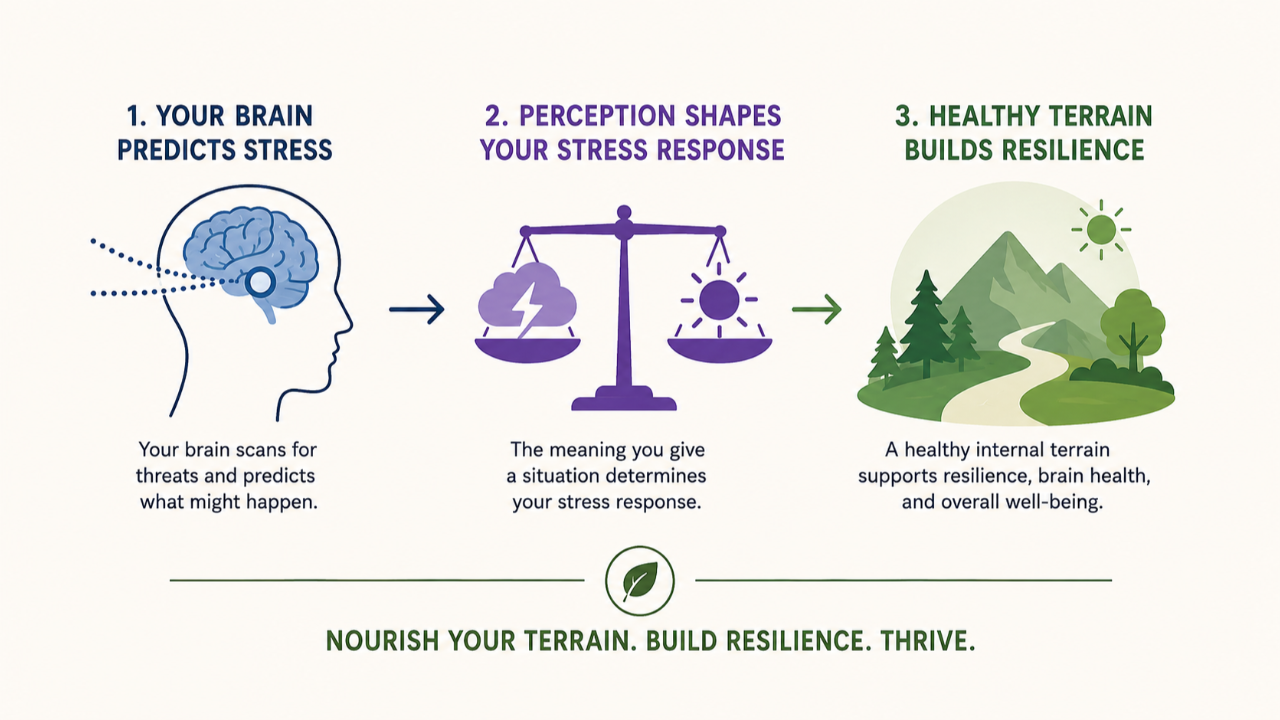
If you've ever wondered why one person remains calm during a difficult situation while another feels overwhelmed, the answer isn't simply personality. It's rooted in neuroscience.
Many of us assume the brain functions like a camera taking in information, analyzing it, and then deciding how to respond. Modern neuroscience, however, suggests something quite different. Rather than simply reacting to the world around us, the brain is constantly making predictions about what is likely to happen next.
Every moment of the day, your nervous system is asking questions such as:
- Am I safe?
- Is this familiar?
- Should I prepare for danger?
- Do I have the resources I need to handle what's coming?
Long before you're consciously aware of a situation, your brain has already begun making educated guesses based on everything it has learned throughout your life. Those predictions influence your heart rate, breathing, hormone release, muscle tension, immune activity, and many other physiological processes that shape your stress response.
Your Brain Is a Prediction Machine
Your brain processes an astonishing amount of information every second. If it consciously analyzed every sight, sound, smell, sensation, and memory individually, it would quickly become overwhelmed. Instead, it relies on prediction to make sense of the world efficiently.
Using previous experiences, memories, emotions, body sensations, and environmental cues, the brain continually creates its best estimate of what is happening now and what is likely to happen next. Think of it as an internal weather forecast. Rather than waiting for the storm to arrive, it looks for patterns and prepares in advance.
Most of the time, this predictive system serves us remarkably well. It helps us react quickly, conserve energy, and stay safe. However, predictions are based on past experience rather than perfect knowledge, so they aren't always accurate. Sometimes the brain predicts danger when no immediate threat actually exists.
Why Two People Can Respond So Differently
Imagine two people walking into the same crowded room. One immediately feels energized by the conversation and activity, while the other becomes tense and wants to leave.
The room hasn't changed, but each person's brain is interpreting it through a different lens. Every nervous system brings its own history into the present moment. Previous successes can build confidence, while difficult experiences may increase vigilance. Childhood environments, chronic stress, illness, trauma, and even persistent inflammation all influence how the brain predicts future events.
This helps explain why comparing ourselves to others is rarely productive. Two people can experience the exact same situation yet respond very differently because their brains are working from different experiences and receiving different information from their bodies.
In other words, stress isn't determined solely by the event itself. It's also shaped by how your brain predicts and interprets that event.
Your Body Is Constantly Communicating with Your Brain
We often think of the brain as the command center directing everything else in the body. In reality, communication is continuous in both directions.
Every moment, your body sends information back to the brain about its internal environment. Blood sugar levels, inflammation, immune activity, hormone communication, breathing patterns, heart rate, gut health, sleep quality, pain, and muscle tension all become part of the information your brain uses to update its predictions.
If your body consistently sends signals associated with imbalance, the brain may become more likely to interpret situations as threatening even when they are relatively safe. This doesn't mean the danger is imaginary. Rather, it means your brain is doing exactly what it was designed to do: protect you using the information it has available.
The Role of Inflammation
One of the most fascinating discoveries in recent years is that inflammation doesn't only affect the immune system or cause physical discomfort. It also influences how the brain processes information.
Research suggests that inflammatory signals can affect areas of the brain involved in mood, motivation, attention, and threat detection. As inflammation increases, the nervous system may become more vigilant. Situations that once felt manageable may begin to feel more stressful, and recovering from everyday challenges may take longer than it once did.
This is one reason supporting metabolic health is so important. Healthy sleep, nourishing food, regular movement, and adequate recovery don't just benefit your muscles or your immune system, they also help create an internal environment that allows the brain to interpret the world more accurately.
The Importance of Safety Cues
One of your brain's primary responsibilities is determining whether you are safe. Interestingly, it doesn't make that decision based only on major life events. Instead, it continuously gathers evidence from the small experiences that fill each day.
Consistent sleep habits, balanced meals, time outdoors, slow breathing, physical activity, prayer, music, supportive relationships, and moments of quiet all provide signals of safety to the nervous system. While none of these habits eliminate life's challenges, together they reassure the brain that the body has the resources it needs to adapt.
Over time, these everyday experiences help your brain distinguish between ordinary stressors and genuine threats, allowing you to respond with greater resilience rather than unnecessary alarm.
What This Means for Your Terrain
One of the central principles of terrain-based wellness is that every system in the body influences every other system. The brain is no exception.
A healthier terrain supports steadier blood sugar, lower chronic inflammation, healthier mitochondria, restorative sleep, balanced hormone communication, and improved immune regulation. Together, these factors provide the brain with more reliable information about what's happening inside the body.
That doesn't eliminate stress or prevent difficult circumstances. Instead, it gives your brain a stronger biological foundation from which to interpret those challenges more accurately.
When your internal terrain is healthier, your brain is often better equipped to distinguish true danger from everyday uncertainty. This allows your stress response to become more appropriately matched to the situation rather than remaining on high alert.
A Different Way to Think About Stress
The next time you notice yourself feeling stressed, resist the urge to immediately ask, "How do I make this feeling go away?"
Instead, consider asking a different set of questions:
- What might my brain be predicting right now?
- Is there genuine danger, or is my nervous system trying to protect me?
- What signals of safety can I offer my body in this moment?
Sometimes that signal may be taking a slow breath, stepping outside for fresh air, eating a nourishing meal, calling a trusted friend, or simply recognizing that your brain is doing exactly what it was designed to do.
The goal isn't to eliminate every stress response. Stress is a normal and necessary part of life. The goal is to support a healthier internal terrain so your brain can make more accurate predictions and respond with greater flexibility and resilience.
Final Thoughts
Your brain isn't passively waiting for life to happen. Every moment, it is actively anticipating what comes next, and those predictions influence your thoughts, emotions, hormones, immune function, and overall stress physiology.
The encouraging news is that your daily choices help shape those predictions over time. Every nourishing meal, every restorative night's sleep, every walk outdoors, every meaningful conversation, and every intentional moment of recovery becomes another piece of evidence your brain uses to answer one of its most important questions:
"Am I safe?"
As you continue caring for the terrain of your body, you're doing more than supporting your physical health. You're also creating an internal environment that helps your brain interpret the world with greater clarity, resilience, and confidence.
If you are interested in more information, schedule a free Discovery Call.
Let's stay connected!
Join my free Terrain Wellness Community
or sign up for my mailing list to receive the latest news and updates.
I will never sell your information, for any reason.
